You can but this will be inspected in detail by the examiner. The examiner will follow these points to determine if the anchorage points are suitable.
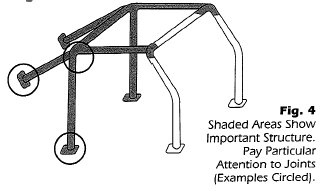
What to look for:
• Triangulation and bracing which will provide strength and spread the loads effectively into
the chassis.
• The joint where the roll cage joins the chassis and the chassis itself must be sufficiently
strong to withstand the loads from the anchorages.
• Upper anchorage must be adequately braced from near the anchorage to strong areas of
the chassis.
• Threaded seatbelt anchorage fastening should be welded into tubes or onto plates of
sufficient thickness.
• Bolted joints joining the cage to the chassis and parts of the cage to each other should be
of sufficient strength.
Note: For guidance roll cages should ideally be manufactured of COS steel tube dia 45mm x
2.5mm wall thickness OR dia 50mm x 2.0mm wall thickness. Bend radii should exceed 3 times the tube diameter. Where tubes are ovalised during bending, the ratio diD should not be less than 0.9 (d=small diameter, D=Iarger diameter).
Cause for concern:
• Roll cage manufactured using aluminium.
• Poor bolted joints, or joints that could separate due to loads in anchorages.
• Insufficient bracing or bracing to upper anchorage too low.
• Roll cage material cracked or badly creased.
• Cage-to-chassis mounting plates of smaller thickness than cage wall thickness.
• Cage not attached to chassis, or insufficient joint strength.