This is a read-only archive of the old Madabout Kitcars forum. New posts and replies are no longer possible, but every thread is still here to browse and read.
Hi guys,
I am almost at the point of bonding my body to the frame/floorpan.
I have purchased both bonding paste and matting, but wanted some advice on the best way to join the body to the frame.
I have quite a few places when the parts are at right angles or have 1" gaps between them.
Should I be making up some right angled glass matting first and rivet/bond this to the frame before lowering the body or will the bonding paste act like a weld and the I can glass over the joint.
Any pictures will help loads
Thanks HM
Hi guys,
I am almost at the point of bonding my body to the frame/floorpan.
I have purchased both bonding paste and matting, but wanted some advice on the best way to join the body to the frame.
I have quite a few places when the parts are at right angles or have 1" gaps between them.
Should I be making up some right angled glass matting first and rivet/bond this to the frame before lowering the body or will the bonding paste act like a weld and the I can glass over the joint.
Any pictures will help loads
Thanks HM
Make sure your body will sit exactly where you want it, then apply big dollops of paste on all the points where the frame touches or comes close to the shell. Then strap the body in place where you want it and bridge the floor to the inside of the shell with glass matting and resin each side. Leave to cure for 24 hours and it should feel really strong. A very satisfying part of the build.
Guys I have had some free fix bonding paste for about 4 months and last. Weekend mixed it 4% by weight with catalyst. However it does not seem to be going off ans setting hard. Will it be the cold conditions or does the stuff have a shelf life?
Cheers HM
The weather and temp will play a part but I'v had a 5kg tub of the stuff for well over a year and I am still using it with no problem.
Like Mr t's it starts grey and turns blue when mixed.
I am thinking about bolting my body on, as I think mine will need some R&D in the first few months so having the option of full body removal with make thing a lot easier.
I agree, I think bolting or riviting is a better way to go. It gives more flexibility and is more durable. If you are going to bond, then make sure where you bond the body to. I'm sure the bonding paste will stick pretty good to the GRP body shell. And hold. But what is on the other side of the paste?
Suppose it is wood. Then it would be intresting how this wooden surface is further attached in the construction. And what happens over a few years of usage? Is the wood going to rot? Will it at least swell with moist? Will the bonding paste take along (peel) the upper layer (skin) of the plywood under stress?
Are you bonding it to steel? Or, are you in fact bonding it to the paint that is on the steel? And how is that paint attached to the steel? What happens when there is the ineventable corrosion?
In my opinion, these cars we are making should last. They are much to pretty for short time thinking. I would say it is worth the little extra effort.
Guys,
Thanks for the replies. I am using the bonding paste to
join.the Metalwork to the bulkhead before applying fibreglass matting over the top.
Join a fibreglass bulkhead to the sides of the body, shaping the bonding paste into a fillet shape before again pasting over with fibreglass matting.
Could it me that my catalyst has gone off or I have not added enough?
I might just scrape it off and mix some more with more with new catalyst as a test
It has still not gone off!
I think christinedmc is right on the nail. All those points are well valid.
I have just bonded my body (A352 to Spitfire tub) and worried about bonding to rust, paint etc.
On the sills I used lots of big stainless steel self tappers which should be enough along with the bonding paste.
At the nose and tail, I used big stainless bolts just to be sure.
Ref the shelf life, I have had polyester filler for two or three years and it is still good to use. Before it becomes useless, it kind of dries out and becomes stiff to work with, then you know its time to renew.
I have often wondered about this. If in the future you need to remove the grp shell to carry out rust repairs/engine or gearbox swap etc. just how easy would that be if you have bonded the shell down??
I had seen.. on the cobra episode of wheeler dealers a grp shell that could be lifted off after removal of a series of fixing bolts. That seemed really convenient!
I think the trick here is to make sure that there is NO rust and all the metal is new, or as new, then the body should not have to come off while you own the car! (10 - 15 years or so)
I plan to attach mine so that it is removable. I just need to decide how. There are two reasons; the first is that I like the idea of being able to strip it for maintenance, and the second is that I like the idea of a second body that I can use. It would be the same colour but with different design details. But, that is the dream of an idiot because the first one is so far from being finished.
A removable body does seem to make the old inspection a bit of a waste of time.
Thanks scottie, I guess it's not an issue if you only intend to own for 10 years (i love your build by the way)
I'm with you oxford. After putting in so much work/hours into a car, I'd like to know that i could replace or fix something if i needed to in years to come.
My herald is a big boys meccano set and if i were to rebody it, as i'm considering, i'd love to keep the ability to get to everything if i needed to!
Another one here that isn't a fan of the bonding method, i started to cover how it was going to be done in my build thread but didn't get round to finishing it before i left.
In my heart, I think I agree with both of you, I suppose I'm lazy!
I'm thinking " sod it" its on now and that's that!
It seems that it has taken me so long to get this far, the thought of taking the body off at a later stage kind of freezes my brain!
It wasn't the thought of taking the body off that drove me to try something different in joining the body to the chassis it was more along the line of "What the hell do i do if one of the bonded joints lets go?" The thought of having to spend time hanging upside down to get access to a failed joint put a shiver down my spine
... If in the future you need to remove the grp shell to carry out rust repairs/engine or gearbox swap etc. just how easy would that be if you have bonded the shell down??
... I had seen ... a grp shell that could be lifted off after removal of a series of fixing bolts. That seemed really convenient!
I thing a few things might be getting being mixed up here.
First up, with the Sammio/Ribble/Miglia kits, engine and gearbox swaps would take place as normal through the engine bay with the body in place.
These kits were designed to have the body bonded to the frame work / floors / bulkhead and it is the frame that is bolted to the chassis.
So once you have formed a new body tub, there is no reason why you couldn't remove the whole thing.
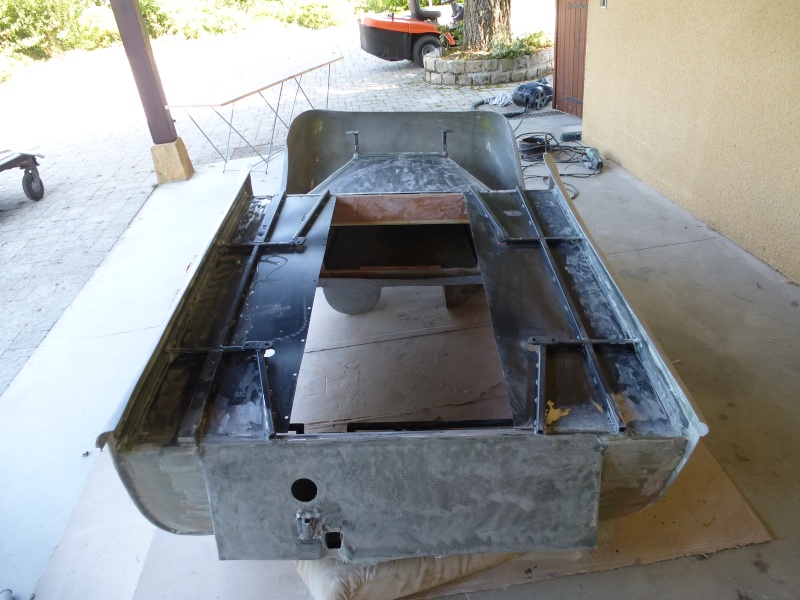
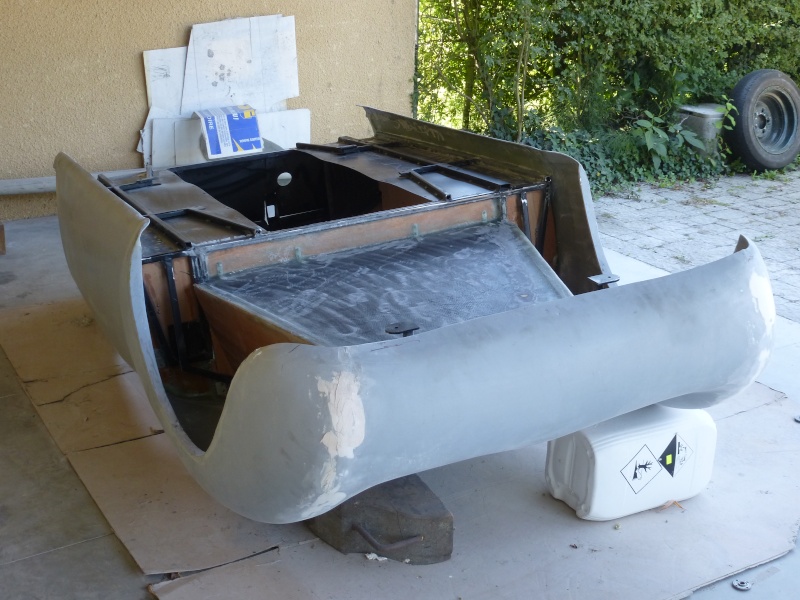
This the 2CV body kit & frame work build by zèbre69 / Sebastien:
To me it is just the same as my donor Spitfire's body shell.
(Although it will be significantly lighter! :icon_wink
Just to be crystal clear, the body shell is not bonded to the chassis.
You should also be aware that this build route evolved to comply with the re-body rules.
This is a quote from another forum by the guy who helped make sure the original Sammio Spyder was legal.
[COLOR="Blue"]... if you WELD the body to the chassis it is classed as "extending chassis parameters" which renders the vehicle liable to BIVA. A body must always be bolted to the chassis. If you use a subframe ie bolt that to the chassis and then bolt the body to that it is also BIVA territory. The body must bolt directly to chassis so any subframe must be incorporated as a permanent part of the body to be acceptable for rebody regs...[/COLOR]
So it is OK for builders to bolt their body to the framework, but not to the chassis.
Sorry for just a long winded reply, but I hope it helps, Paul.
PS HouseMartin - Any more news on your bonding?
Plus how about a few photos?
I think that has cleared a few things up for me with regard to any future work needed on the chassis itself, as you could just unbolt your body/bonded frame together and lift it off. And yes it would be lighter than the original tub.
Just one thing to clarify though mate
If you use a subframe ie bolt that to the chassis and then bolt the body to that it is also BIVA territory. The body must bolt directly to chassis so any subframe must be incorporated as a permanent part of the body to be acceptable for rebody regs...
So it is OK for builders to bolt their body to the framework, but not to the chassis.
That seems to say (sorry if i get this wrong as i've not had my morning coffee yet) that you can bolt your body/bonded frame to the chassis, but you cant bolt your frame and body together. So I guess you need to make very sure you're happy with your frame's strength/shape etc when you bond the two together!
Been watching this topic develop for a while now. Bonding the body to the frame and the interior panels to the body and floor is what gives the shell its rigidity.
If your body moulding is the same as mine, which it probably is, it's a lightweight layup that has all the structural integrity of a blancmange until it's fitted properly. I firmly believe that if you bolt it to the frame instead of bonding it at all contact points it'll flex and you'll get cracks all over the place.
If you go back and read the 'getting started' page on the Sammio web site (originally written by Gary J)
... Just one thing to clarify ... you cant bolt your frame and body together...
Apologies in advance for another long winded reply...
You can bolt your frame and body together, but only if you then made this a permanent arrangement.
E.g. Fibre glass over the nuts and bolts on both sides.
The point is that the original body tub was a single unit (see previous photos), so it's replacement must be a single unit, not two parts bolted together.
These kits are using re-body rules and whilst the two bodies can be different in looks, they can't be different in construction method.
So as the body shell of the original Spitfire / Herald was not bolted together, neither can its replacement.
Misted Towed's link to the original build "manual" is showing you how to do this and stay within the re-body rules.
There is nothing stopping you constructing a kit any way you like, but you will need to pass the IVA test if it is not a "simple" re-body.
If it's simply bolted to the chassis AND body, it could be argued that it's an extension to the body, [COLOR="Red"]equally it could be argued that it's an extension to the chassis - this would require IVA[/COLOR] To avoid this, it must become a "permanent" part of the body. Glossing over the nut/bolt heads would work but bonding is a much better way for the reasons MrT gave.