This is a read-only archive of the old Madabout Kitcars forum. New posts and replies are no longer possible, but every thread is still here to browse and read.
I may have asked this before but can't find the thread if I did.
Can anyone advise on a suitable/good clutch master cylinder to use on the sportster. I bought an E36 salvage one from Quarry Motors thinking I could use a standard BMW part but then discovered that the peddle box has been designed for one with the mount points co-axial to the cylinder rather than at right angles. I could hack the pedal box up to fit but it seems a lot of hassle.
Looking through other peoples builds it seems that the BMW part used to be the way to go but now an off the shelf part is favoured. I was looking at these on CBS but have no idea of the quality/source
I used a standard BMW master cylinder, although I did significantly strengthen the pedal box around it.
There are a three things to look out for:
The master cylnder appears to be mounted on its wrong side, so you have to make spacers to stand it off the pedal box.
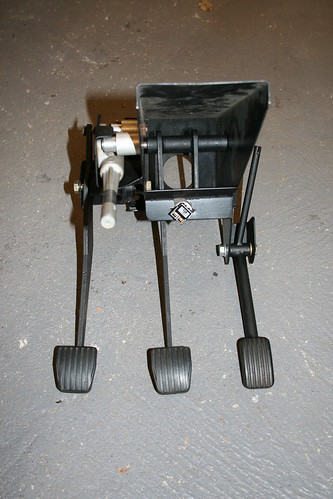
The second is to fix the master cylinder to a hole in the clutch pedal at about 50mm from the pivot (I tried it in the top hole at 80mm first, as shown in this photo, and the pedal was incredibly hard, and only had half travel distance).
The arc of the pedal can only just be coped with by the master cylinder pushrod, so it is critical to mount the master cylinder at the perfect angle relative to the pedal box.
Mike
morris wrote:
Hi All,
I may have asked this before but can't find the thread if I did.
Can anyone advise on a suitable/good clutch master cylinder to use on the sportster. I bought an E36 salvage one from Quarry Motors thinking I could use a standard BMW part but then discovered that the peddle box has been designed for one with the mount points co-axial to the cylinder rather than at right angles. I could hack the pedal box up to fit but it seems a lot of hassle.
Looking through other peoples builds it seems that the BMW part used to be the way to go but now an off the shelf part is favoured. I was looking at these on CBS but have no idea of the quality/source
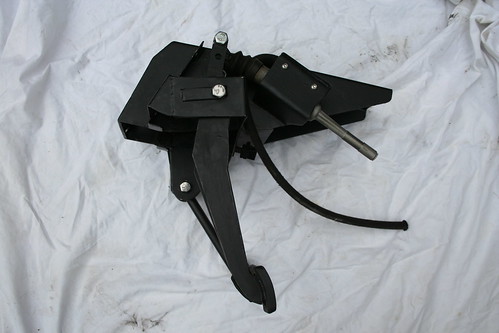
yep, the way both of you have set things up is what I'd anticipated from memory of reading other peoples build logs. It's my own fault, I should have stuck my head in the foot well to take a look before going ahead and ordering the BMW part. If you look at this photo you can see what I mean about the peddle box design having changed
It definitely suggests the girling cylinders and to hack it up to use the BMW part seems like a lot of extra effort especially as I only paid about a tenner for it
That look as if it's designed for a willwood master, like I have. My pedal box was the old style, for the BMW master. My old BMW master was shot, so I got a new one from Marlin - which happened to be a wilwood one. So I ended up fabricating brackets for it to work with the pedal box.
A very interesting thread as Mike's comment mentions "the pedal was incredibly hard, and only had half travel distance" with the master cylinder attached at the 80mm hole which he then transferred to the 50mm hole.
My pedal has the same feel to it, that is, incredibly hard and a short travel.
Will have to look at mine to see if that fix is possible as mine is E30 based.
Not a lot of help to you though Ian.
A very interesting thread as Mike's comment mentions "the pedal was incredibly hard, and only had half travel distance" with the master cylinder attached at the 80mm hole which he then transferred to the 50mm hole.
My pedal has the same feel to it, that is, incredibly hard and a short travel.
Will have to look at mine to see if that fix is possible as mine is E30 based.
Not a lot of help to you though Ian.
Hi Dennis
The shortening is fairly straight forward - drill a new hole closer to the clutch pedal pivot. The problem then that I experienced was that the master cylinder was at the wrong angle relative to the new hole, and the push rod did not have sufficient angle of movement to accommodate. I had to slightly rotate the fixing holes of the master cylinder to accommodate: it now works fine.
My clutch bites approximately half pedal , and travels to around 90% of the potential travel.
I would suggest 45mm might be better than than 50mm, but you only get one go at deciding where the new hole should be!
if you get a wilwood master, you will also need a 7/16" UNF adaptor / barb to screw into the fluid inlet, so you can attach the fluid feed from the resevoir.
A very interesting thread as Mike's comment mentions "the pedal was incredibly hard, and only had half travel distance" with the master cylinder attached at the 80mm hole which he then transferred to the 50mm hole.
My pedal has the same feel to it, that is, incredibly hard and a short travel.
Will have to look at mine to see if that fix is possible as mine is E30 based.
Not a lot of help to you though Ian.
And Dennis, if it helps, this is what mine currently looks like...
Not the best photo, but I think you can just see I used the top hole and put a return spring in the second (lower) hole. Clutch travel and feel has been fairly 'normal/hard'.
During my recent engine swap, I had to install a new clutch as the 325i is actually different to the 320i. Initial impression is that the clutch pedal travel seems to be shorter but that maybe because I haven't run the engine and everything has not settled down yet. My old clutch was a Sachs and the new one is a Valeo so it's also possibly due to different manufacturers, but I have no evidence of that.
Crikey, you boys are a mine of information and help. Thanks very much.
Attacked my mudguards over Xmas to modify the same as Robin's, as I have these wide wheels. Works very nicely and you get used to the wing stays going through the side instead of underneath like the rest of yours. Still gets the wobbles of course, but put them in for respraying today after filling in the redundant holes. Am having them sprayed black like Patricks, so there will be two dark blue sportsters with black mudguards. Mines not as pretty as Patricks though. A few things to change over time to achieve that. Probably hood then wipers next. Good job I have your sites to look at for guidance.
Oh, forgot the servo of course.
a small order for the master, reservior, feed hose and clevis kit should see this particular problem solved
I was going to pay my local hose and fittings man a call at [URL="torques.co.uk"]torques.co.uk[/URL] as he'll put together an SS clutch hose kit with the specific fittings for both the master and slave ends
a small order for the master, reservior, feed hose and clevis kit should see this particular problem solved
I was going to pay my local hose and fittings man a call at [URL="torques.co.uk"]torques.co.uk[/URL] as he'll put together an SS clutch hose kit with the specific fittings for both the master and slave ends
I was going for the 0.75" bore as that's what marlin offer for sale and was also working on the principle that the larger the diameter bore the greater the surface area and hence pressure the cylinder can exert. As the foot well space is limited I figure the lighter the clutch the better
I was going for the 0.75" bore as that's what marlin offer for sale and was also working on the principle that the larger the diameter bore the greater the surface area and hence pressure the cylinder can exert. As the foot well space is limited I figure the lighter the clutch the better
Is that the smallest bore, as that will be the easiest pedal pressure?
no, that's the largest. I think the smallest is 0.6". Have I got it the wrong way round? is it a big bore you want at the slave end? a bit late now as I just ordered all the parts from Rally Designs. Oh well, we'll see how it pans out
no, that's the largest. I think the smallest is 0.6". Have I got it the wrong way round? is it a big bore you want at the slave end? a bit late now as I just ordered all the parts from Rally Designs. Oh well, we'll see how it pans out
You can drill a new coupling hole in your pedal closer to the pivot to reduce the pedal pressure ie you make the pedal travel further to achieve the same amount of clutch displacement.
I would suggest trying to mock up the pedal arrangement, but outside of your footwell (I set mine up as a test rig alongside the engine bay) to see how much travel is needed to get the clutch to open, (put the engine in gear and get a helper to try to turn a rear wheel while you effectively depress the clutch. This will give you a good idea of where the bite point and total travel will be. I t will also let you test the feel of the pedal. I tried to set my bite point at the same travel as my daily driver. This is then a good point to drill the coupling hole in your pedal.
I am aware that I am a newcomer to the Marlin world, and that in many cases I would be a fresh member of the congregation preaching to the bishops, but this custom clutch and brake installation is a common dilemna.
Here in the US,I have been involved with a number of Cobras with 500+RWHP, on platforms grossing less than 1000Kg.
Getting the acceptable clutch pedal travel and weight involves, in my humble experience, 8 factors.
1. How much you boot that pedal with your left foot
2. The length ratio between the pedal pad and the lever length above the pivot
3. The fluid displaced by the travel of the master cylinder seal when put into motion by #2 above
4. The ratio between the master cylinder and slave cylinder dimensions and fluid displacements, if these 2 items are not similar in size and volume.
5. Any loss in this fluid transfer efficiency IF the connecting hose is not an armoured type, and expands under pressure thereby reducing the fluid transfer.
6. How much the slave cylinder rod travels to move the clutch lever from engaged to dis-engaged clutch disc.
7. The ratio between the clutch lever fixed pivot point and the slave cylinder travel distance, and the clutch lever fixed pivot point and the release (thrust) bearing retainer aperture.
8. The designed weight of the clutch disc motion fingers, and sometimes whether the fingers have centrifugal throw-out weights built in.
Definite a lot to think about, but can be "brained" out with a calculator and some good measurements.
Same thing with brake hydraulics, which was why I raised the point back in my earlier brake bias related question.
I am aware that I am a newcomer to the Marlin world, and that in many cases I would be a fresh member of the congregation preaching to the bishops, but this custom clutch and brake installation is a common dilemna.
Here in the US,I have been involved with a number of Cobras with 500+RWHP, on platforms grossing less than 1000Kg.
Getting the acceptable clutch pedal travel and weight involves, in my humble experience, 8 factors.
1. How much you boot that pedal with your left foot
2. The length ratio between the pedal pad and the lever length above the pivot
3. The fluid displaced by the travel of the master cylinder seal when put into motion by #2 above
4. The ratio between the master cylinder and slave cylinder dimensions and fluid displacements, if these 2 items are not similar in size and volume.
5. Any loss in this fluid transfer efficiency IF the connecting hose is not an armoured type, and expands under pressure thereby reducing the fluid transfer.
6. How much the slave cylinder rod travels to move the clutch lever from engaged to dis-engaged clutch disc.
7. The ratio between the clutch lever fixed pivot point and the slave cylinder travel distance, and the clutch lever fixed pivot point and the release (thrust) bearing retainer aperture.
8. The designed weight of the clutch disc motion fingers, and sometimes whether the fingers have centrifugal throw-out weights built in.
Definite a lot to think about, but can be "brained" out with a calculator and some good measurements.
Same thing with brake hydraulics, which was why I raised the point back in my earlier brake bias related question.
Very comprehensive - you'll be up for ordination very soon!
Do you know where you can get the answer to No. 8? All the rest are mechanical measurements of length or surface area.
This will no doubt be specific to your particular pressure plate and disc combo, but Borg and Beck, or Ford Racing should have the theoretical data in their tech sections.
I will ask the guys in our race shop this morning where we find the BMW specs.