This is a read-only archive of the old Madabout Kitcars forum. New posts and replies are no longer possible, but every thread is still here to browse and read.
OK, I admit it - I know nothing about engines and cars!!
I would have thought fitting an expansion tank would be simple..... but google is not my friend any more...
Do I need an expansion tank or a header tank? sealed and pressurised or not?
I've found so many contradictory articles I'm lost...
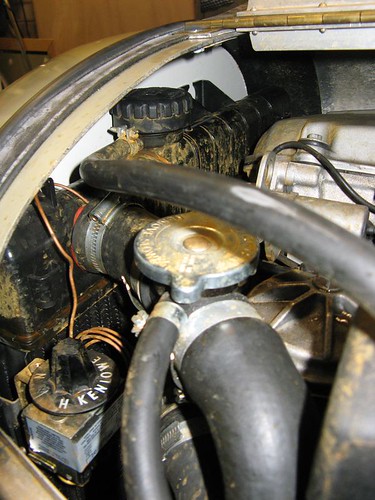
This is my "plumbing" at the moment - radiator connected to "engine" and the overflow linked effectively in the circuit. I have no heater to complicate issues... http://www.flickr.com/photos/7757983@N07/3924362942/
Where should my expansion tank go? I think in the loop between the "overflows". But expansion tanks seem to have overflows on them that would idicate the system is no longer "pressurised" and sealed - or have I lost the plot ?
Last question - does it matter where it goes vertically in relation to the rest of the system?
The header tank/expansion tank is the same thing if it plumbed into the main system - you essentially mount it as the highest point of the cooling system and half fill it to allow for the air to be compressed inside, it helps if you feed a small coolant pipe into it as well so the water does not become stangent.
Another option is the way you have it plumbed up at the moment (partly), the overflow pipe next to the filler on the rad should be vented to either air or the bottom of a catch tank so if a vacuum is formed inside the cooling system once it has cooled down the water gets sucked back into the system instead of air being drawn in. If you use this method the un-pressurized expansion tank should be vented at the top to free air.
Hi Andy,
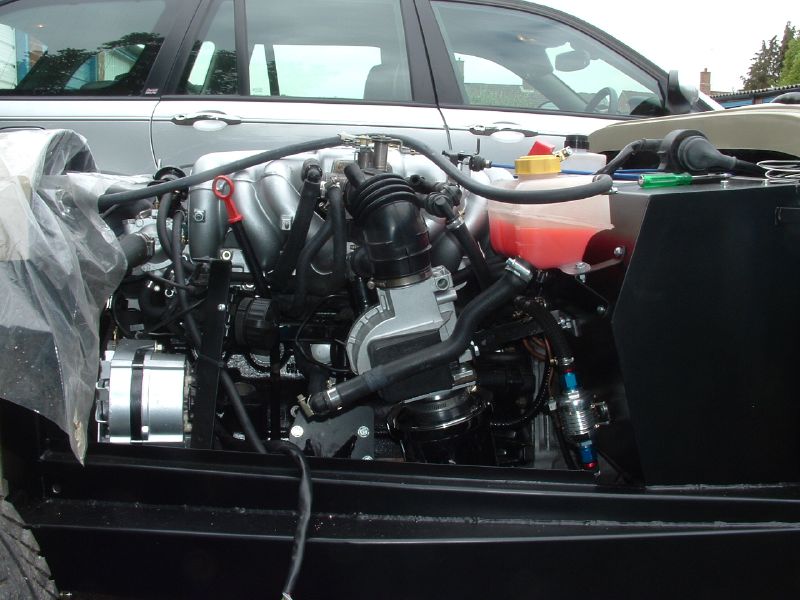
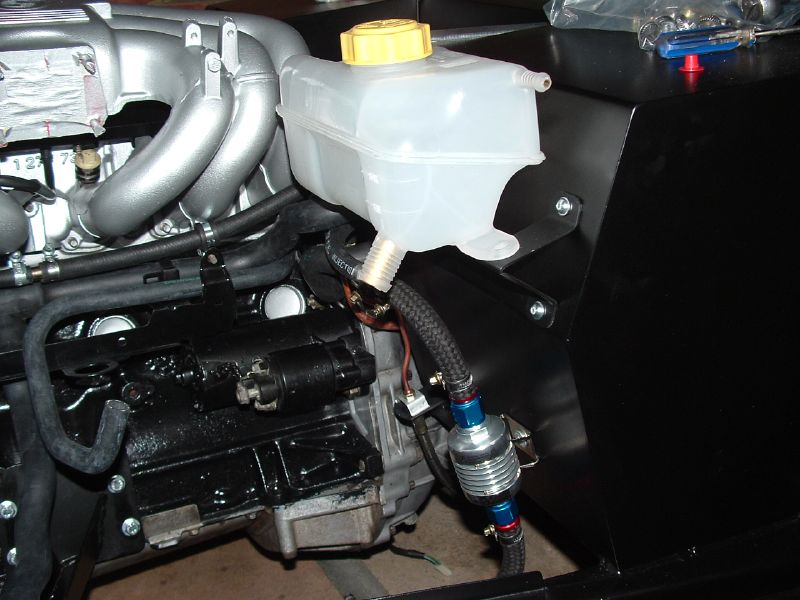
not sure if you're sorted but here's a picture of my header tank.
The lower outlet goes to a tee piece into the hose that goes to the heater and the small hose at the top goes to the tee piece in your top radiator hose.
The tank is made by Ford but I bought mine direct from Westfield off their website.
On the same subject as cooling, I stumbled on a discovery.
My car was running very hot at about 95°C-105°C.
It's got an M50 engine fitted with a 91°C thermostat with an early M10 type radiator.
By drilling three 5mm holes at the top of the thermostat the temperature is a lot lower.
Warming up time is a little longer but the car now runs at 80°C-85°C on the road raising to 95°C in a traffic jam.
I think that the stat wasn't quick enough for the smaller rad or something.