This is a read-only archive of the old Madabout Kitcars forum. New posts and replies are no longer possible, but every thread is still here to browse and read.
I've currently got 190mm ground clearance front and rear, but that's on 13" wheels and without the engine and gearbox in place. I'm hoping to end up with about that once the 14's are bolted up and the engine and box are refitted.
.
Where are you measuring from ?
I have used a standard 1" Lowering block at the rear on a swing spring and I am measuring 180mm from the lower point of the chassis, Is that the difference a swing spring makes as I have nowhere near the set up you have at the back.
Yes, I'd noticed that too. It looks like there's a massive difference in the setup between the standard Vitesse/Herald rear spring and the Spitfire swing-spring conversion.
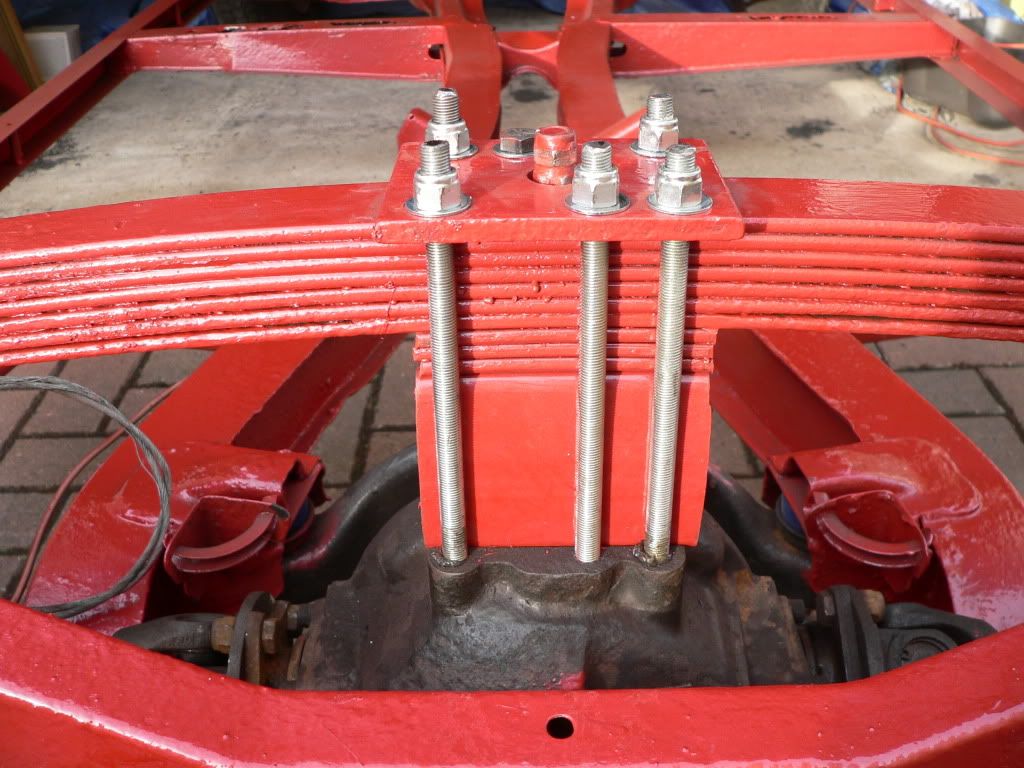
I've put in a 4" lowering block plus I've dropped it an extra 18mm by cutting down three of the discarded top leaves and putting them between the top of the lowering block and the bottom of the spring.
This gives me a total drop of about 118mm and leaves 19cm between the ground and the lowest part of the differential at the back. My 95mm cut on the front springs has given me the same clearance at the front, but that's without the engine and 'box fitted.
One thing I have noticed is that when I lift up the back end now the wheels stay upright without tucking under at all. It looks like the radical lowering job limits the downward travel of the rear wheels so much that it's eliminated the dreaded jacking effect.
It'll be interesting to drive each others' cars once they're finished to see if there's any noticeable difference between standard spring and swing spring handling.
Im no expert on suspension but have been trying to get my head round how it all works, I realise the more distance you put between the spring and the chassis then it dumps it lower to the deck but, does the strut length stop it going lower as this is the one point you haven't altered? Once your camber has been pushed out to the limit then it cant go lower, this would explain why you get no tuck at all now, does it also stiffen the suspension more as the spring must now be under a lot more tension..
I wonder what the effect will be on road holding, maybe someone with a bit of experience can answer.
Like you say when we finally get on the road we can swap out and see, your not so far from me, once its all done a summer meet up may be on the cards
Pops
I'm no suspension expert either although I have dramatically lowered a Beetle before with no resultant handling problems. As it had started out its life as a semi-auto it did have the Porsche style double jointed rear drive-shafts though, rather than the swing-axles found in most Beetles and all Heralds/Vitesses.
I'd say that my lowering job on the back end is about equivalent to a 2" drop on an otherwise standard Vitesse, despite having put in about 6" of lowering blocks.
This means the back suspension is pretty much in the position it would be in if the Vitesse was fully laden with passengers and luggage.
The discrepancy is due to having removed about 300 kilos of bodywork, seats and glass which were compressing the suspension at rest.
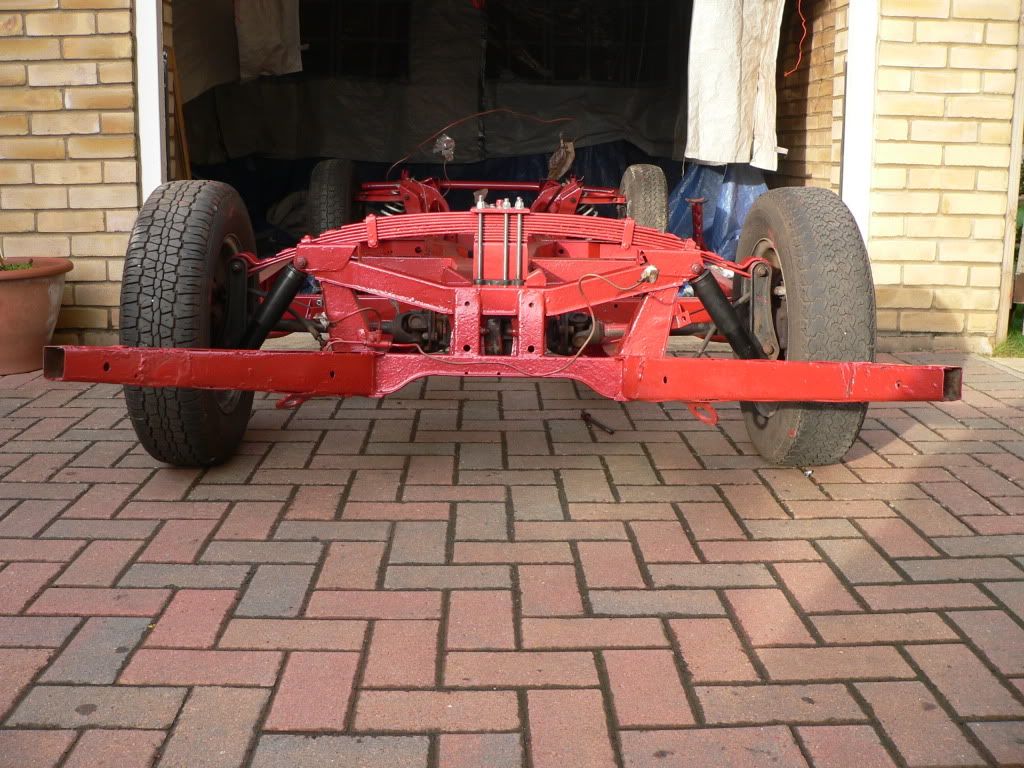
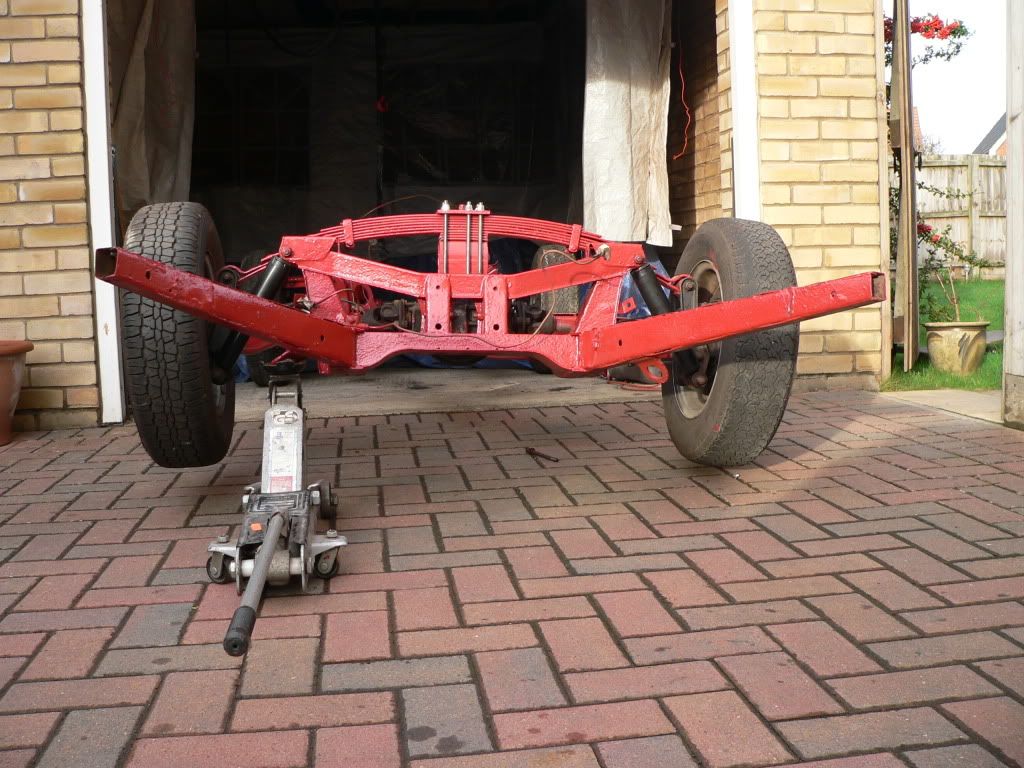
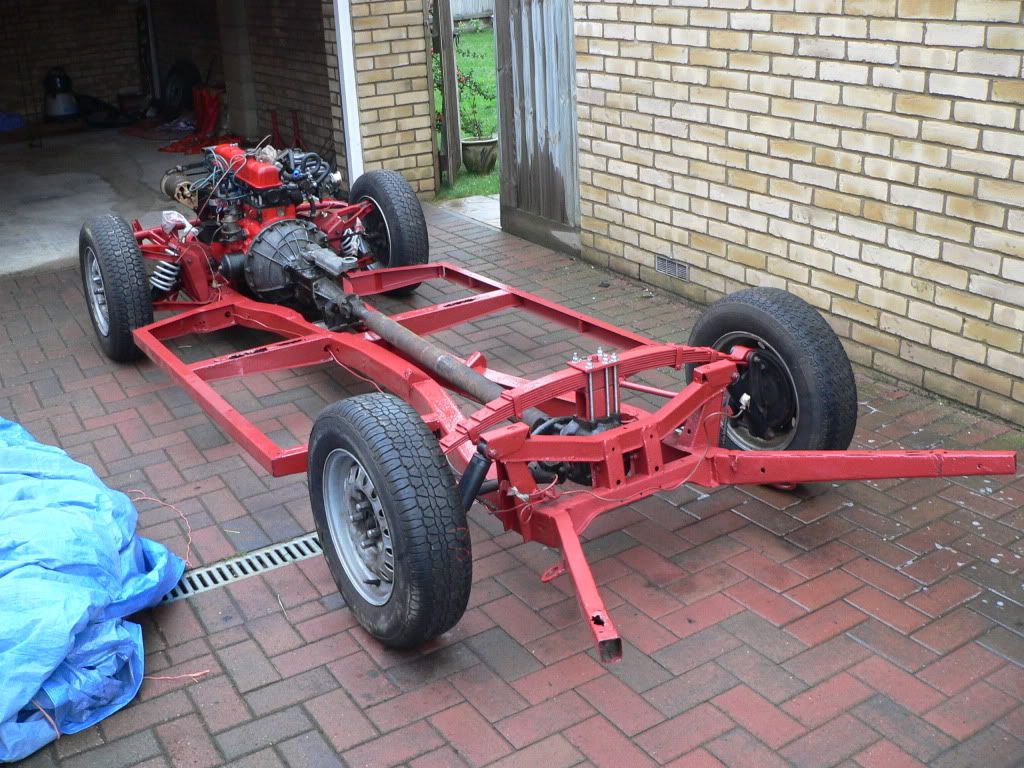
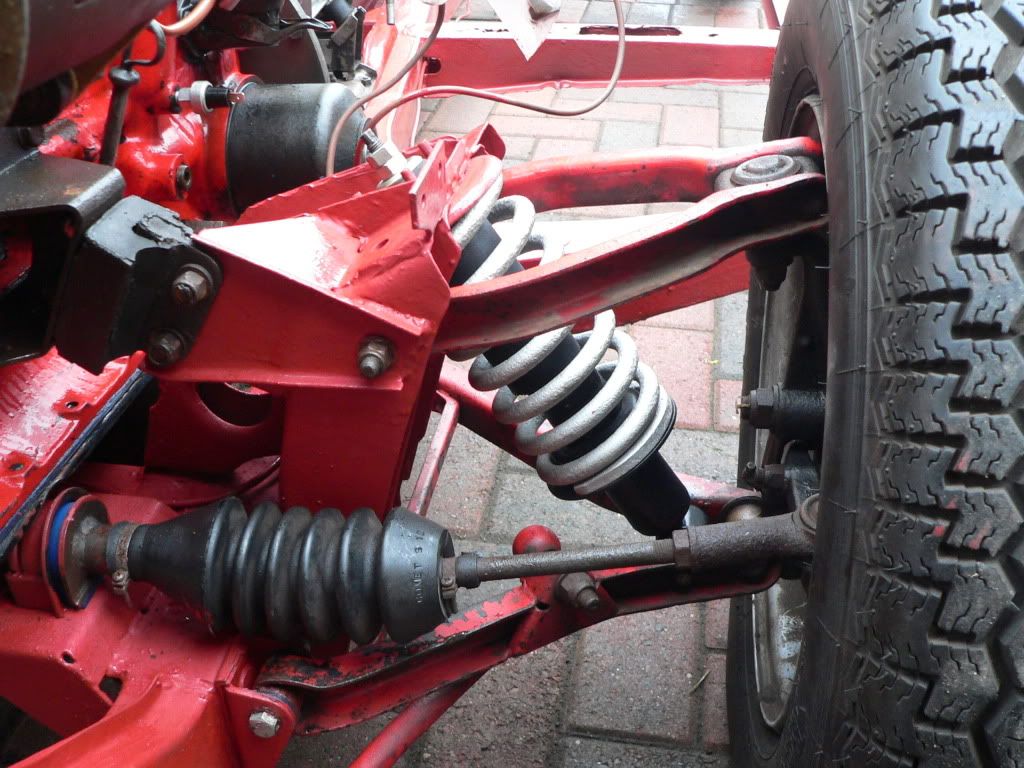
The pictures below show my rear suspension set-up better than I can describe it:
The second picture shows the negative camber on the rear wheels, which isn't too extreme imho and the received wisdom suggests will improve grip during cornering.
The third picture shows how the unwanted tuck-under effect has been all but eliminated by raising the spring in relation to the diff. I've jacked up the nearside rear and, if you look closely you'll see that the off-side wheel has also lifted off the ground even though the nearside wheel remains almost vertical.
This set-up should give me pretty flat cornering and definitely no rear wheel jacking.
I seem to recall someone giving Gary a hard time about his choice of donor a year or so back on one of these forums, claiming that his Spyder would be 'unsafe at any speed' due to rear wheel jacking (a reference to the mother of all American 'class' lawsuits brought against Chevrolet by the families of those killed in Corvair crashes).
The third picture here shows that it won't be a problem while Gary has sold more kits this year than most kit-car manufacturers sell in a lifetime so whoever you were, you can shove your criticism where the sun don't shine!
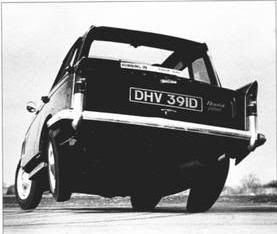
Just in case anyone's unfamiliar with the swing axle jacking and tuck-under that I've been talking about, take a look at this:
What's happened here is that this Herald has first been thrown round a right hand bend causing the off-side rear wheel to droop to its full extent, effectively tucking it under the back of the car.
The driver's then suddenly switched to a left hand bend causing the outside edge of the off-side wheel to 'bite' the road surface and jack the whole back end up in the air. The resultant switching between oversteer and understeer as the suspension tries to settle itself down again is impossible to control even for a skilled driver and many a Herald/Beetle/Corvair made holes in the scenery during spirited driving.
Solutions included attaching straps between the drive shafts and the underside of the car body to limit the downward travel of the suspension, fitting a 'camber compensator', a double ended clamp that's still available for Beetles, to the drive shafts to prevent too great a difference developing between the two sides and, of course, the the swing-spring, which allows the leaf spring to slide from side to side, effectively moving the top mount of the rear wheel during cornering to keep the wheels more upright.
'Bit of brain fade I'm afraid - I've just taken some measurments and my lowering block is 3" not 4". With the extra cut down leaves I've actually raised the spring by 95mm, which is exactly what I've cut out of the front springs.
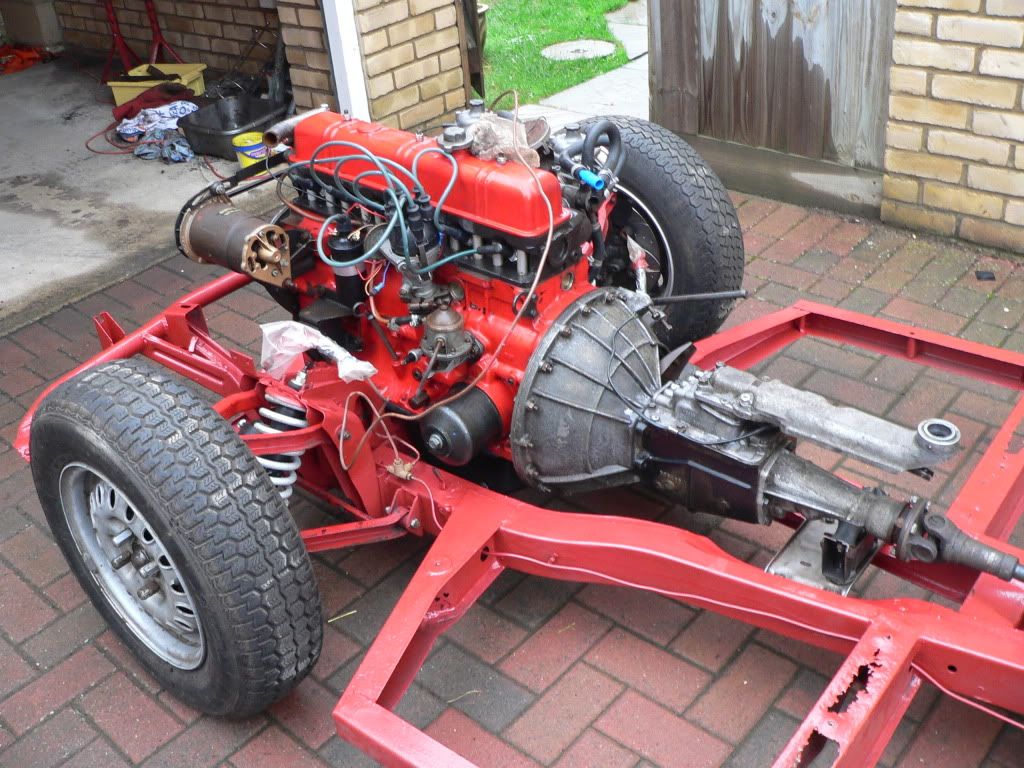
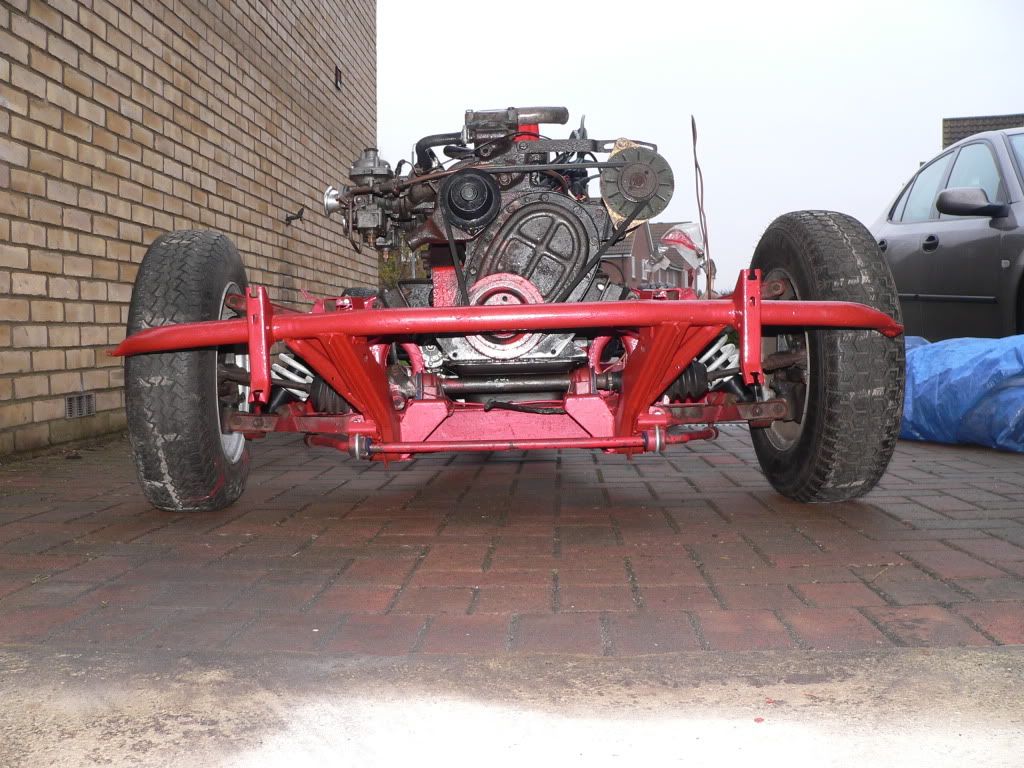
Dropped my engine and gearbox back into the chassis today and I was a bit taken aback by how much the weight of the straight six compressed the front suspension:
Methinks 95mm might have been a tad much to cut off the front springs with a Vitesse engined Sammio as I now have only 120mm ground clearance at the front.
I'll stick with it for the time being though as my old Beetle was considerably lower than even that at the front, and, although it did scuff the odd speed hump it drove fine. If the stance looks odd or the suspension bottoms out during spirited driving I'll source some new springs and give them a bit less of a shave.
I took 80mm off on mine (also a 2L) and i think mine is LOW.
Remember you've still got bulkheads etc. to fit! Maybe time to invest in some of the GAZ height adjustable shocks?
That aside it's looking really nice! Knowing what i know now, i sort of wish i'd stripped mine right the way back. but we live and learn!
'Been fretting a bit over the 120mm ground clearance my Spyder's now got at the front end: will it foul speed bumps or bottom out on bumpy roads?
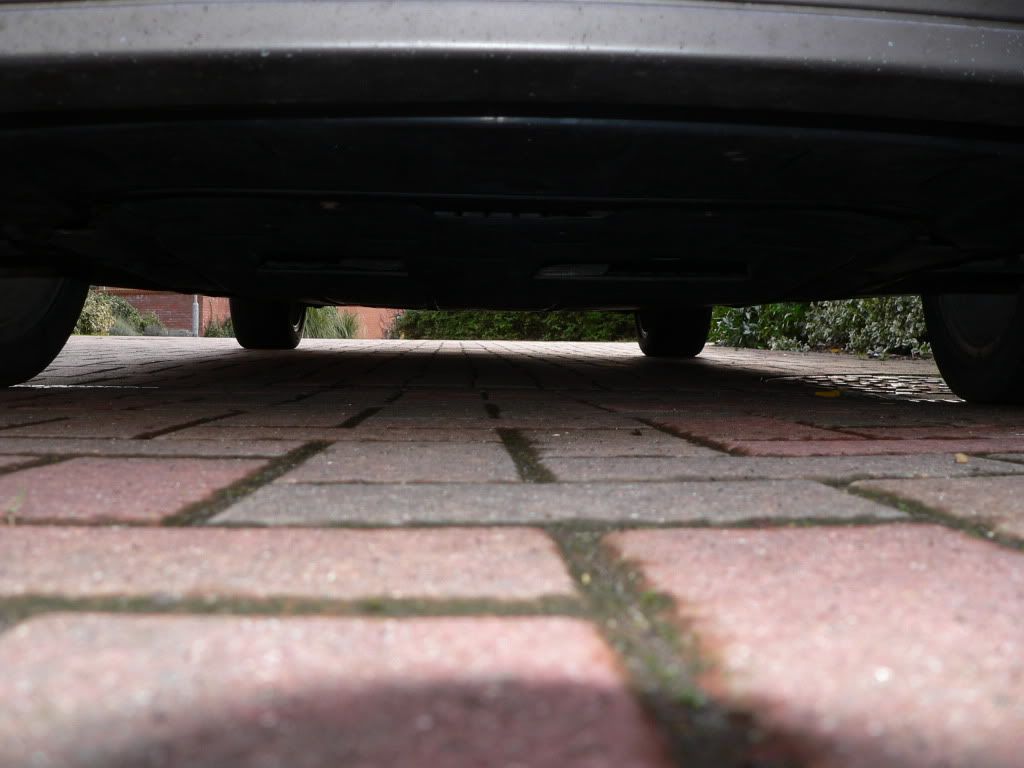
So I decided to shove a tape measure under my bog standard Saab 9-3 Vector to see how much more ground clearance I'd need to engineer into the Vitesse chassis.
The Saab turns out to have only 110mm clearance under the sump cover and hasn't fouled anything (apart from the odd pheasant) or bottomed out yet so I should be ok after all!
Had a couple of hours to work on my Spyder today so decided to get the waxoyling done.
Having never used it before I kind of assumed it would be a liquid that I could spray using my compressed air driven paraffin gun. I followed the instructions, standing the tin in hot water for an hour and then decanting it into the paraffin gun resevoir.
Thing is, waxoyl isn't exactly liquid. It's more the consistency of the stuff you see in the sewers outside kebab shops on 'Life of Grime', a sort of fatty gloop. So, when I pulled the trigger on my paraffin gun all that came out the end was air.
I guess I'll have to bite the bullet and invest in one of waxoyl's own pressure ised application systems.
Anyway, as it was clear I wasn't going to get anything substantial done today I decided to bolt up the adaptors for the first time and fit my refurbished wires on the front end to cheer myself up.
Even with the scrubbed out old 165x14's that they came with I'm really pleased with the look.
They also raise the ride height by 15mm to 135, allowing my trolley jack to fit underneath, which it won't with the 13's fitted, and increase the track into the bargain.
I'm still undecided about the final tyre choice though: I had settled on 175/70/14's but I do love the taller sidewall look of the 165x14's. Decisions decisions...
I personally like a taller tyre on the cars - looks a bit more period ....obviously crossplies would be even more period but I am assuming you want to keep the car in a straight line !
Looking forward to seeing this one with the body on...
Next job will be repairing the bulkhead then modifying and fitting the loom and the fuel pipes so I can get the beast fired up and running again before fitting the body.
Having seen it on the MGB wires now I really want to stick with 165/14's, and yes, I'd like to be able to steer and stop so cross-ply's are a definite no-no.
The choice seems limited to a couple of modern budget brands, Falken SN-807's at about £55 each fitted, for example, or mega expensive name-brands like Vredestein Sport Classics at over £100 each.
Anyone know of a source for mid-range name brand 165/14's?
I got my local garage to do some ringing around and we ended up with a sort of medium range tyre for about £65 each i think. i know i'm on 15's but if i'm allowed a garage-pass in the next few days, i'll get the brand for you
Hi towed,
What's the sidewall height on the 165, is it 70% I too like the look of a taller sidewall but am ever mind full of the wheel diameter increasing.
Pops
Hi towed,
What's the sidewall height on the 165, is it 70% I too like the look of a taller sidewall but am ever mind full of the wheel diameter increasing.
Pops
They're 165/80/14's and the side-wall is 13.2cm
With these fitted the steering can be put on full lock in both directions without the tyres fouling the chassis. I'd say there's about 10mm clearance but I haven't tried it with the bulkhead fitted yet.
The annoying thing is there's loads of choice if I want 175/70/14's (12.25cm side-wall, too small?) or 175/80/14's (14cm side-wall, will foul?) but hardly any 165/80/14's.
I initially used to work out the side-wall heights with a calculator but I find this site really handy for such tasks...
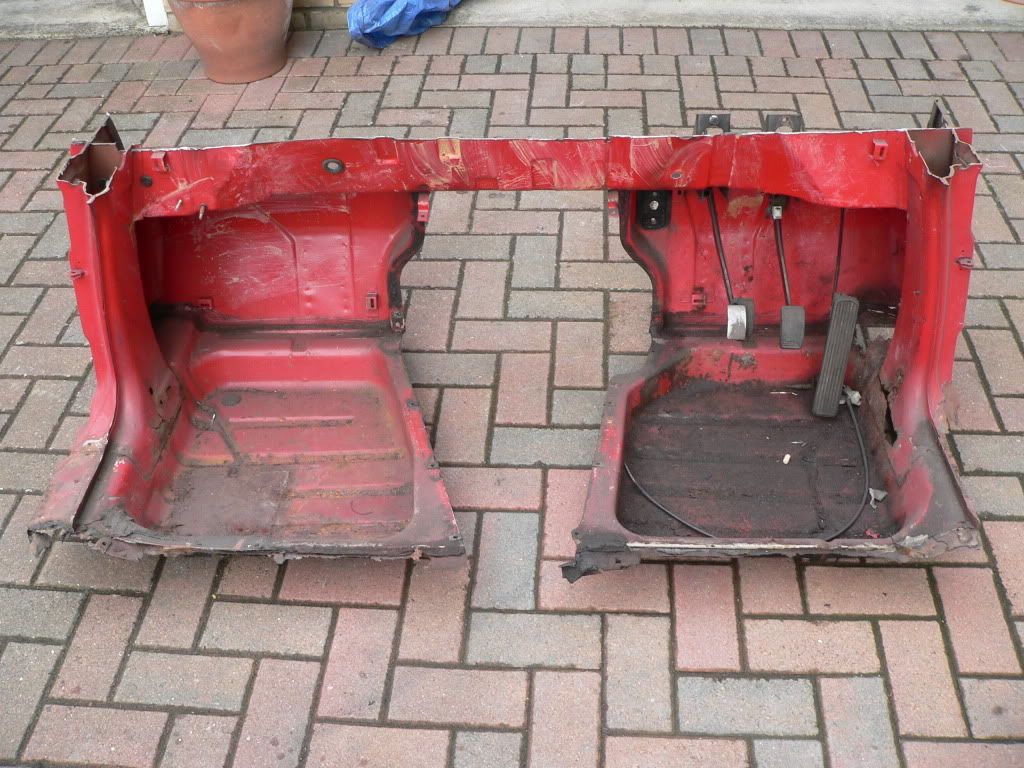
Started blasting the bulkhead today, most of it is covered in bitumen underseal which is taking ages to remove.
It's in pretty good condition from the top down to the top edge of the floopans, but like a doily below that. Will be firing up the welder again once I've got it all back to bare metal.
Some 'before' shots below, will post 'after' shots once I've made some progress...
Yep, new floorpan will be going in on the driver's side. Will try to repair the passenger side but have a feeling Canleys will be getting another order...
I know its crap restoring before modifying ...but when its done its done...if you know what I mean.
Will be good for a few years....whats good about the regulations regarding SVA Exemption , is they state the body must be removable - it would be easier to build these as permanent fixings but , by insisting they are removable , when everyones restoring these cars in 20/30 years time ...the bodies can be removed to make life easier.....
not that I will be restoring any in 30 years time ........