This is a read-only archive of the old Madabout Kitcars forum. New posts and replies are no longer possible, but every thread is still here to browse and read.
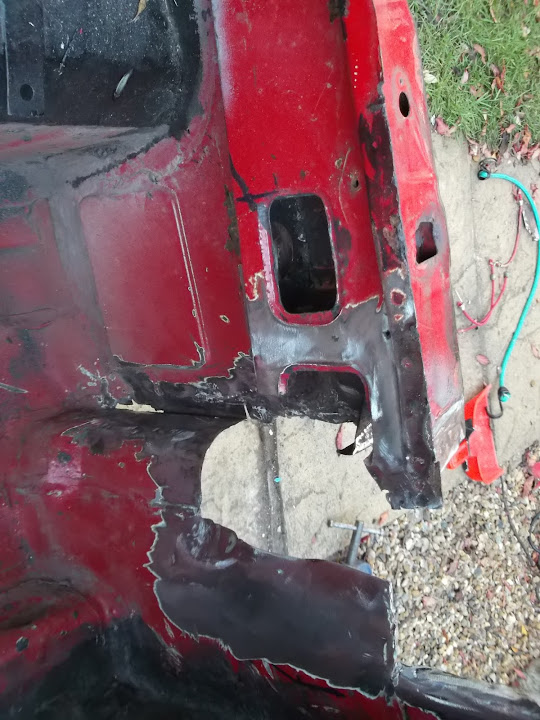
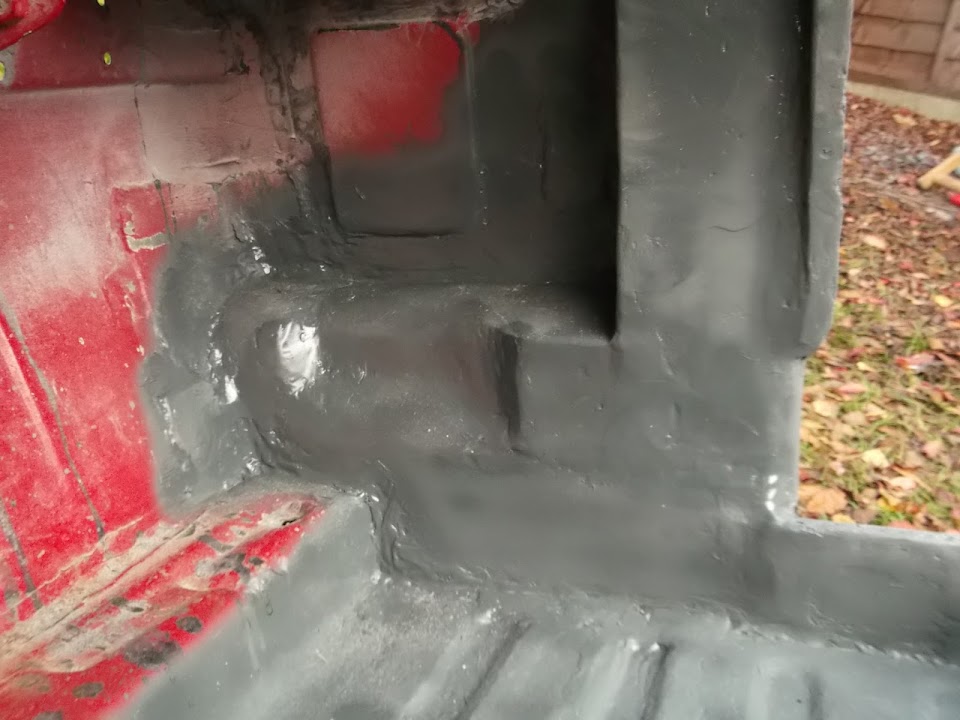
Hi Deni, your welding looks to be pretty good to me (if any pro welders disagree, please bear in mind that I'm a self-taught amateur welder myself, so I just mean it looks strong enough for our purposes), while your fibreglassing also looks like it'll do the job, just watch out for bubbles when using the cloth rather than the matting.
As for a fibreglass bulkhead being an mot fail, possibly your mate might have experience of an mot tester failing fibreglass repairs to a corroded structural bulkhead in a monocoque car, but there's nothing in the MOT Testers' manual to suggest that bulkheads need to be metal, otherwise how would fibreglass cars like Lotus Elans, Elites, Europas and Reliant Scimitars pass their MOT's?
The pertinent sections of the MOT manual for us are:
Appendix A, Section 8 - Vehicles with Separate bodies. This accepts that, where a vehicle has a separate chassis and body with supporting sub-structure, it is the integrity of the sub-structure that is critical, not the condition of the body.
Main manual, Section 6 - Body Structure and Attachments. Again, this talks about corrosion but not materials used to construct the vehicle in the first place.
Also, it's worth trawling round your local MOT testing stations until you find one who understands classic cars, hot rods and specials as they're far less likely to reject a car on the basis that they just don't understand it.
'My' tester, for example, drives a 70's Toyota Celica with a V6 motor grafted in and is restoring a pre-war Morris. He won't break the rules to get my cars through the test, but he will very carefully read the guidance notes and apply the rules appropriately to a non-standard vehicle.
I'd also point out that, once correctly registered (emphasis to try to avoid any accusation of using photoshopped registration documents from Rochdale GT) your car will almost certainly be MOT exempt anyway.
Having said that, it'll still need to be both safe and road-legal, and I personally will continue to MOT my classics/kits just for the peace of mind of an annual independent safety check.
Anyway, good luck with your Miglia, it looks like you have or are developing all the skills you'll need to do a fine job.
Sorry for repeating some of what Paul says above, I hadn't noticed that he'd posted while I had breakfast.
Thank you for replying so quickly, on a such a lovely Christmas day.
Barber - Thank you for your comments. I would recommend to try using a MIG welder. It just seems easier to use compared to an Arc welder.
Paul L and Mister Towed - Thank you for your encouragement and advice too, as well as for the clarification regarding the bulkhead, very helpful.
I am still in two minds about the bulkhead. If I decide to use fibreglass one I might clad it with thin, lightweight aluminium just to be safe. Paul I enjoy reading your on the road blog and Mister Towed, I also follow your new roadster build - I hope to see more developments soon.
I know that the regulations have changed and that already registered cars, older than 40 years are tax and MOT exempt, but I will continue to MOT my car anyway, just to stay safe (I have another classic car from 1976).
However, I am not sure what happens in our case, when we have to put the car back on the road after the build, so I have a few questions please:
1- I know that in the past people would send the papers to DVLA to change the details on V5 before having their MOT done. Is that still the case please? Can I already send the documentation to DVLA? If not, how do we go on about this currently please?
2- If a donor car is MOT free, is it still required to do your first MOT when you've finished re-body-ing a car?
Hi Deni, this have changed since the local DVLA offices have closed as every thing is now done by post!!!eep:
To correctly register your car you'll need to fill-out form V627/1 and include receipts, photos ect.
Personally, I send the completed V627/1, the current V5 (with changes clearly marked) , receipts for the body conversion, a good photo of the car before, during and after the conversion (clearly showing the registration number), plus a photo of the chassis plate number or stamp and engine number.
I also included a new MOT certificate, this proves the car has been built to a road worthy standard, confirms the conversion is completed, confirms the chassis number, confirms the colour change and in most cases the MOT tester will change the VOSA details on his computer i.e. model, colour ect.
.IMHO I think DVLA look upon a MOT test as a form of "independent" inspection.
So it's worth sending a few quid getting an MOT test when your build is ready and before you register it.
Another thing to remember is when fill-out the V627/1 you only give basic simple understandable information and never mention "kit" or "used" or "second hand".
In my recent experience and using the info above the re-registering process takes around 2 weeks from posting the paperwork to receiving the up-dated V5.
micky1mo - thank you for the advice, very helpful and much appreciated.I am only a bit worried about the fact that I have bought a rolling chassis with engine only, and I don’t have any photos of the donor car before it was stripped down and no original reg plates. I have the chassis plate and correct V5.
It's now common for them to ask for proof that a car exists ie, photo of the car and VIN location, when applying for a new style V5 replacing the old style blue V5.
Not having a photo of the original car displaying it's original registration number might be an issue and DVLA will probably ask for one.
I would recommend doing some research on your car and you might find a photo or reference to it.
After being away for nearly 4 months I am back in the garage to continue working on the Miglia.
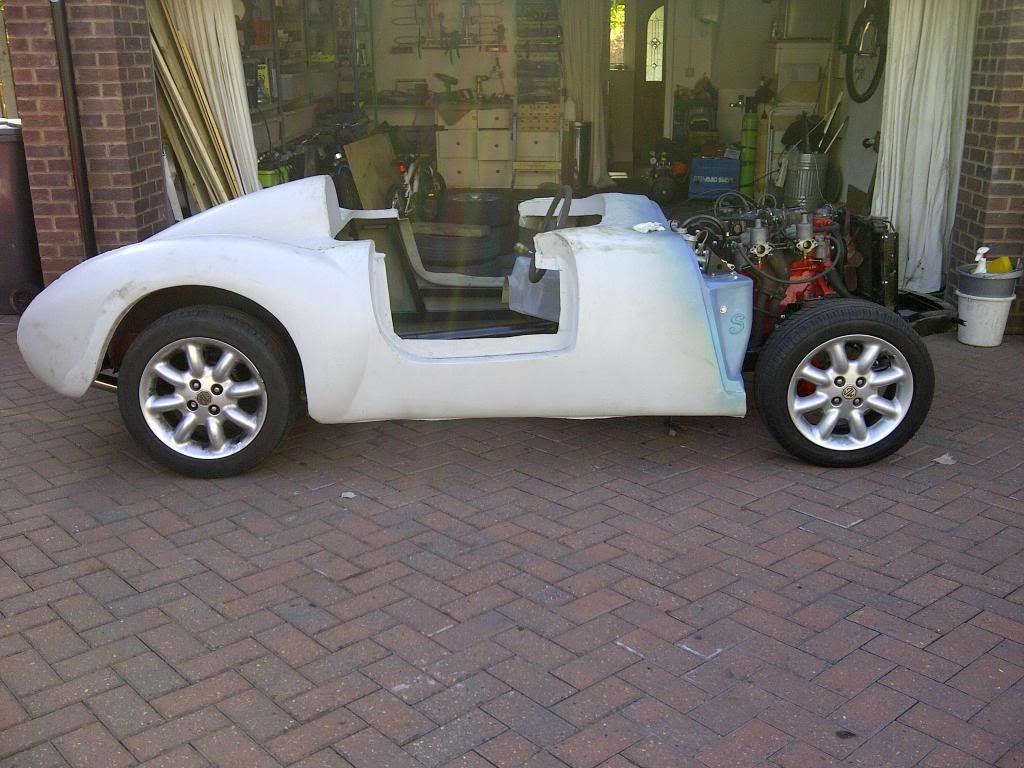
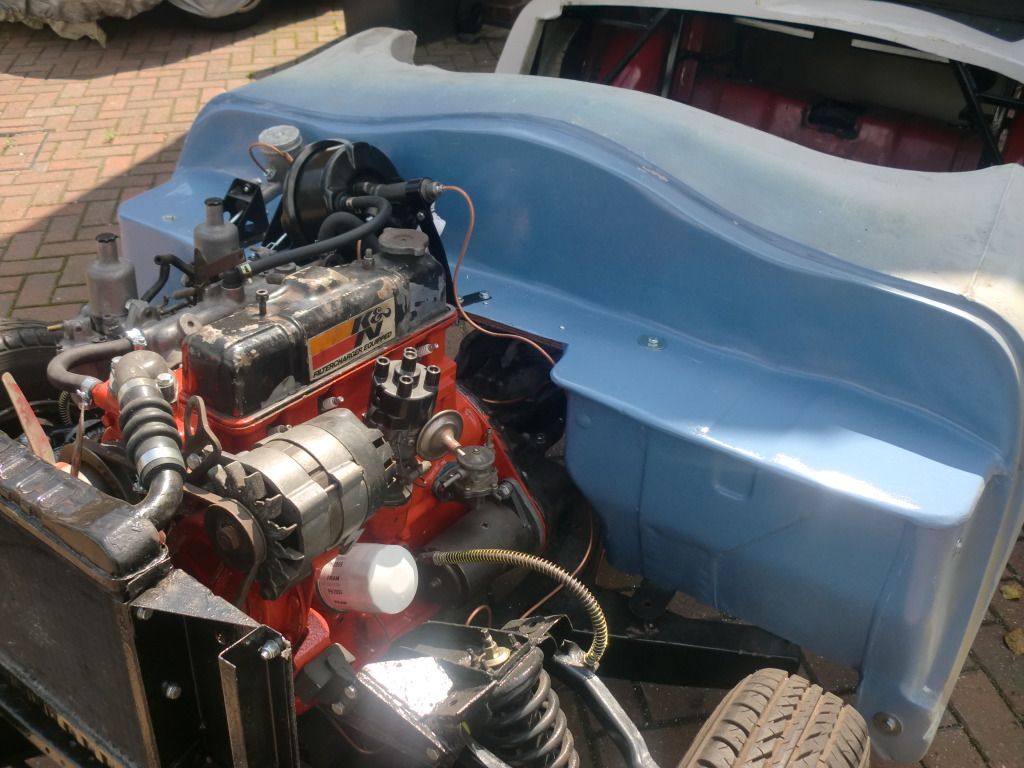
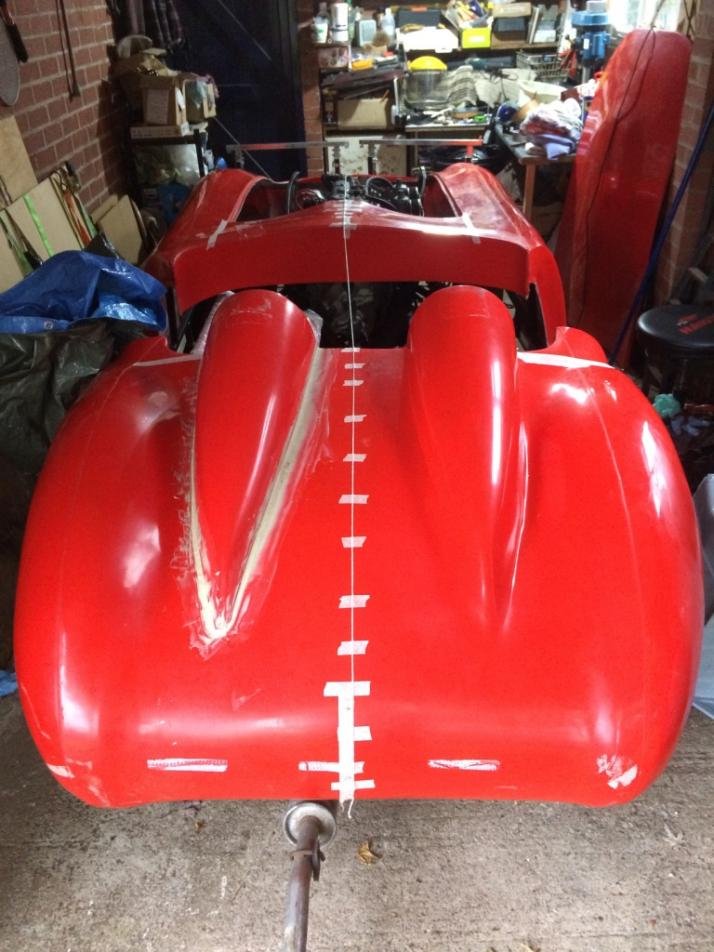
I have done the body trial fit - even if it looks that the body is not very straight, once it is clamped to the frame it actually fits much better and I think I will be able to position it correctly.
I know Chris at Tribute has just corrected the ''leftness'' of these bodies rear ends for a customer by cutting the bulkhead area on the drivers side ...its a fairly easy correction apparently , so might be worth messaging or emailing him .... When the S*mmio became a fully bodied / non flip fronted option , something happened !
Its all fixable though ...
micky1mo - thank you for your advice. I am afraid I will have to research a bit more about this.
lancelot link - thank you for the tip. I will try to have a chat with Chris and check if it is within my capabilities to do what he did. I like how your Formosas look when they are finished, especially the long nose one.
Hi Paul,
Thanks for your comments. You’re right, I am getting better results with more practice.
I have not measured the top of the bulkhead yet, but the idea was (if I decide to use this bulkhead) to make a separate top part and to laminate it to this existing bulkhead copy. I thought it would be easier to finish this part of once the body is in it’s final position and bonded to the subframe.
Hi Paul L - thank you for the link. I was just curious about his experience with painting a fiberglass car using roller. Actually, reading your thread, back then when you were painting the Swordfish, was what inspired and convinced me that hand painting my car is the way to go.
So I will be reading your painting part of the thread again later on, as you have provided quite a lot of detail there, so thanks for that too.
With hindsight, my top lessons learned from hand painting my car are:
Buy twice as much paint as you think you might need as a single batch.
- Due to some bad paint reactions and other problems, I ended up running out of top coat.
- Then the small extra tin I bought to finish the job was a slightly different shade of BRG.
- So I then had to buy even more paint to get the same colour all over from a single tin.
Use paint that is something like Rustoleum or the narrow boat stuff, rather than the synthetic paint I used.
- As whilst the synthetic paint went on shiny using a brush, it didn’t look as shiny when sanded back flat.
Use a proper polishing machine (see JaguarTVR’s suggestions on my build thread).
- As the problems I had with sanding back may have been made worse by using the wrong tool.
Try to avoid painting during the hottest summer since the legendary heat wave of 1976.
Paul L - thank you very much for the advice, very helpful. Rustoleum paint sounds like a good idea. I remember you having a problem with different shades of green, so thanks for the tip regarding the paint quantities too.
You are also right when you say that, no matter how the paintwork turns out, it will not stop us enjoying driving our cars, that's for sure...
However, at the moment I am still "agonizing" as to which type and thickness of the metal I should use to fabricate the bulkhead...or do I use my fiberglass copy of the bulkhead, cover it with thin aluminium sheet to make it more fire resistant and glass it to the frame...or is that a silly idea??? ....any comments and advice would be appreciated.
This is a photo of DonnySoutherner's Cordite build
Which did use the fibreglass bulkhead that the Cordite was originally supplied with.
( I removed this section from my own build as part of 'Project HillBilly'. )
The key point to note is that the framework underneath had a panel to support the pedals.
Given my Spitfire's brakes are a mix of discs and drums, there have been time when I have really pressed the brake pedal.
So I guess ensuring the pedal area is strong enough would be a key point.
But, again, I assume the Griffith shell above is strong enough to support the pedals.
Paul L-Thank you very much for the photos and the link to the Griffith internet page. Looking forward to read it.
My frame came without pedal attachment plate but I have bought a 6mm steel plate to weld onto the frame to mount the pedals, as my bulkhead would not be strong enough.
My main concern is how fire resistant my fiberglass bulkhead would be but the photos you have posted confirm that they are suitable.
Thank you very much for your help and advice, it is much appreciated. I know I have a lot of questions but I will get there...
Just catching up on this, in case it helps i also had to rejig my pedal plate and steering column mounts as well! So (as ever) i went a bit OTT i did a frame extension in 25x25x3mm steel box section with a 4mm steel plate on the top.
After that my bulkhead was fabricated in bonded and rivited aluminium which i got from metals4you.co.uk
I started with this
But also ended up totally altering the steering column part so that i could fit space behind my flush mounted instruments and ended with this.
davecymry-thanks for your help, always much appreciated. Your build pages are my regular place to go when I am trying to figure things out. Good luck with the front springs tinkering...
Hi Dave,
I forgot to ask, Did you put anything in between aluminium and steel frame to separate them? I see on the photos that you have applied something where the rivets are.
The Alloy sheets were 2000x1000x1.2mm
The angle was 3/4 x 3/4 / 1/16
Alloy rivets (LOTS of them)
and everything seated and bonded with Tiger Seal (nasty, horrible, sticky stuff that it is to cut out of your hair)
I've made some progress with my build and have a few more things to do this weekend, so I will post the photos afterwards. In the meantime, I have a question regarding a brake master cylinder.
I have bought a new, updated clutch cylinder with small 3/4 reservoir, but with a larger bore (0.725"). I've been told that I can use the same cylinder for my brakes.
Is the size of the reservoir crucial and will it hold enough of brake fluid for efficient braking (I would like to use this one if possible) or is it necessary to use one with a larger reservoir but a smaller, 0.625" bore?
Any advice would be helpful. My engine is 1500 Spitfire and I have a single brake circuit with discs on the front and the drums on the back wheels.
For some reason my post from today (see below) did not show in 'New Posts' section, so I will post it again.
Hi all,
I've made some progress with my build and have a few more things to do this weekend, so I will post the photos afterwards. In the meantime, I have a question regarding a brake master cylinder.
I have bought a new, updated clutch cylinder with small 3/4 reservoir, but with a larger bore (0.725"). I've been told that I can use the same cylinder for my brakes.
Is the size of the reservoir crucial and will it hold enough of brake fluid for efficient braking (I would like to use this one if possible) or is it necessary to use one with a larger reservoir but a smaller, 0.625" bore?
Any advice would be helpful. My engine is 1500 Spitfire and I have a single brake circuit with discs on the front and the drums on the back wheels.


 eep:
eep:




 ....any comments and advice would be appreciated.