
MadaboutKitcars

This is a read-only archive of the old Madabout Kitcars forum. New posts and replies are no longer possible, but every thread is still here to browse and read.

Dual 7" Servo

14 May 2012, 5:10pm
Hi Peter

Thanks for the response. I am pretty certain my Hunter with its original Sierra/Metro servo setup doesn't have a limiter in the rear brake circuit. I guess I will have to have a play around with it when I come to fit the servo.

To be honest I would be amazed if there is a problem, if Mike and the others didn't have a problem with rear disc setups locking, rear drums should be fine as they are less efficient than discs.

The only problem might be extra pedal travel if there isn't a valve on the rear drums, the MB website seems to indicate this is the only reason they fit the residual valve. I will just have to make sure it doesnt cause binding when the brakes are hot if I decide to fit one.

John
16 May 2012, 11:16pm
The Sierra automatic brake adjusters, need the shoes to be fully "off" so the ratchet engages properly to adjust the mechanism to remove play as the shoes wear. An incorrectly adjusted handbrake cable (too tight) will cause this so I am sure that RPVs will do the same. I believe that you would only need to use RPVs if the master cylinder resevoir is below the brake cylinders as this could cause fluid to bleed back into the master cylinder. However I have a classic car (drum / drum) where the master cylinder is bolted to the chassis below the floor, so well below the wheel cylinders! There isn't a problem with bleed back because the master cylinder is fed from a remote reservoir up under the bonnet, so there is always a head of fluid above the brake cylinders. Peter.
17 May 2012, 7:29am
Thanks for the input Peter.

I am not envisaging a problem, I will be setting things up without an RPV to start with, and only having a rethink if there is a problem.

John
17 May 2012, 8:16am
Grey V8 Pete wrote:
..............I believe that you would only need to use RPVs if the master cylinder resevoir is below the brake cylinders as this could cause fluid to bleed back into the master cylinder............. Peter.


Peter

This echoes what MBM say about the RPV.

Another point to make is that brakes require 900 to 1100psi to make drum / disc brakes work effectively. An RPV with only 2-3psi really should not cause any break issues. As you say its primary function is to prevent bleed back which effectively pulls the wheel cylinders away from the shoes by gravity, making the initial brake pedal travel greater.

Mike
24 May 2012, 9:46pm
Mike, Peter

I'm afraid I have only just seen your PMs re the servo - a failure of my understanding of the site!

I will try and have a look at my servo this weekend and have sent you my contact number on a PM Peter as I would appreciate your input on how best to do it.

Sorton
4 Jun 2012, 9:29am
Whilst browsing through my latest copy of Complete Kit Car I suddenly stumbled on some pictures I recognised !
Yep, it is an article written by Mike detailing the story of the dual diaphragm Servo trials and upgrades. :smile:

Well done Mike, good article! :thumb:
8 Jun 2012, 10:11am
peterux wrote:
Whilst browsing through my latest copy of Complete Kit Car I suddenly stumbled on some pictures I recognised !
Yep, it is an article written by Mike detailing the story of the dual diaphragm Servo trials and upgrades. :smile:

Well done Mike, good article! :thumb:


Hi Peter

I've not seen the article, but it was put together by Ian Stent, based on the articles which went into Pitstop. It will be interesting to see how much he has changed them?

Who's photos has he used?
9 Jun 2012, 7:55pm
Mike wrote:
Hi Peter

I've not seen the article, but it was put together by Ian Stent, based on the articles which went into Pitstop. It will be interesting to see how much he has changed them?

Who's photos has he used?


Hi Mike,

it comes across as an article written by yourself, so i guess Ian has just used his editorial skills. I think it has three of your photo's and one on Ian's final installation.

It's good to get the 'dual booster' some wider publicity :thumb:

...peter
15 Jun 2012, 8:03am
Zinc Servo

Hi Sorton

I've sent you a PM

Mike
15 Jun 2012, 9:35am
Servo Update - For Future Interested Owners

All

For those that have follwed this project, and those who consider fitting a Dual Servo in the future, I would like to now share some background information on this project.

In the original batch of 21 servos we ordered from MBM, 4 members chose the Zinc servo (14 chose Powder Coated, and 3 Chrome).
Peter Edwards was the first to fit his Zinc servo to his road going Sportster, and reported an issue with sticking brakes almost immediately. After quite a lot of discussion in the back ground, and conducting various tests, our conclusion was that there was a fault with his servo.

The three other members were contacted, and asked to carefully test their servos: Robin Martin reported back that he too had the same issue. The other two members, with part built kits, were then asked to test their servos using their daily drivers to provide the vacuum, and we believe they too are experiencing the same issue.

Before other Dual Servo adopters start to worry, the Powder Coated servos are made by a different manufacturer and are different from the Zinc servos. We have tested several of the Powder coated servos, and the Chrome servos, for the same issue, and none have shown any signs of the problem. It appears to be a batch fault with just the 4 off Zinc servos we received from MBM.
(Rob Nicol - you should not be affected as your Zinc servo was the original supplied to me from Duksville UK, and may even be from a different manufacturer)

We contated MBM, as soon as the first two road going zinc servos seemed to be causing problems, and they agreed to replace them without quibble.

When our later tests suggested the final two zinc servos had the same issue, we sent Peter's back to MBM for their comments: their initial report is that there is not a fault. However, we feel they have not tested it thoroughly and seemed to have missed the point a little. I am currently pushing them to carry out further tests to replicate our issue.

Steve Brown at MBM has been very good about all of this: despite finding no fault with Peter's unit, they have now agreed to replace all 4 zinc servos (we have paid to upgrade them to the Powder coated specification). I am now in the process of trying to get MBM to send just two Powder Coated Servos sent separately to the UK, but do appreciate freight works out very expensive for small quantities.

The second batch of 24 servos were all Powder Coated (for reasons which are now obvious, and that it standardised the adaptor plate) so we do not anticipate any further issues.
We now have 40 Powder Coated, 3 Chrome, and 1 Duksville Zinc servos distributed.


So, what can we draw from this experience?

I think MBM have been very good in their dealings with us - and would recommend them to anyone who wants to approach them direct for future orders.

And for any potential users, choose a Powder Coated servo! :nod:
15 Jun 2012, 3:01pm
Mike,

Thanks, I have sent a reply and in case I did not make it clear I would like to upgrade to the powder coated unit.

Sorton
15 Jun 2012, 7:12pm
Crikey, thanks Mike.

Me thinks I will test the brakes in my little private road before I let loose on the main roads only to find they are not performing as expected. Don,t have the zinc ones though.

Mmmmmm
16 Jun 2012, 11:47am
denniswpearce wrote:
Crikey, thanks Mike.

Me thinks I will test the brakes in my little private road before I let loose on the main roads only to find they are not performing as expected. Don,t have the zinc ones though.

Mmmmmm


Hi Dennis,
I think there is no need for you or others with the black powder coated Servo's to be concerned. The issue found is limited to the zinc plated version which, as Mike says, comes from a different production source. To my knowledge, Mike has not had any issues reported on the black coated version and Jason's chrome plated version showed no sign of the problem when I checked it at Stoneleigh.
I have now successfully replaced my zinc plated servo with a black coated version and have not had any issues since fitting it.

...peter
27 Jun 2012, 12:18pm
Servo/Brake Pedal Alignment

This issue was discussed in the early days of this project, but having seen a Hunter with a pedal / servo alignment problem causing significant stress in the servo internally, I felt it would be a good idea to offer the following advice.

To those who have "Seen it, done it, dealt with it" - well done!
To those who may not, or have not, it might be worth checking, and avoiding.


Copy of general advice email issued to all my contacts who gave me email addresses:


Dual 7" Servo Installation Advice.

Dear All

One of our Dual servo adopters has come across a problem with the installation of his Dual 7" servo. It may possibly have contributed to its failure. Even if not, I would like to pass on the scenario for you to check, and avoid in your installation.


The current Marlin pedal box has been designed not to have the brake pedal axis at right angles to the push rod of the servo - see below (and the same will apply to the Dual 7" servo). In later models the pedal box has an angled bulk head face in the engine bay for the servo to attach to, whilst in earlier Cabrios, the pedal box face was parallel to the pedal, but then the servo was installed at an angle by adding 2-3 washers between the pedal box and the servo on the offside studs only. This slanted the servo/master cylinder in towards the engine front, and away from the body side panel.

The effect of this angle between brake pedal axis and servo is important, and should not be ignored.
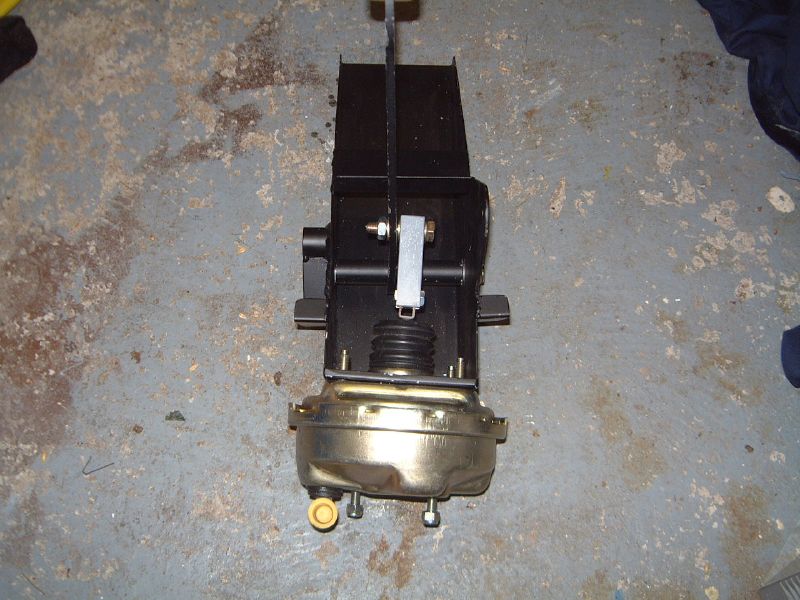


Although the new servo has an input pushrod which has some degree of flexibility in its angle - you can test it on your own servo by pressing it from side to side - it is also important that the clevis can rotate ('wriggle') on the pedal bolt sufficiently for it to align in parallel with the input push rod of the servo thereby avoiding any side pressure on the servo.

In the early Hunter installation which has run into a problem, the brake pedal has had the bolt welded in to the pedal - making it a rigid angle. The owner then fitted the clevis (which was a tight fit to the bolt), and included a nut between the two clevis legs. He then fitted a nyloc nut done up reasonably tightly. The overall effect of this installation was that the clevis was held rigidly at 90 degrees to the pedal, and was not able to rotate (wriggle) latterally to line up in parallel with the input shaft of the servo. When the servo was bolted to the pedal box tightly, this rigidity caused a significant side-ways pressure to be exerted on the servo end of the pushrod. This can not be good, and could lead to premature failure of the servo internal workings.

This scenario is easy to avoid - open up the two holes of the clevis with a 10mm drill bit before fitting - preferably as an oval, allowing the clevis to rotate laterally on the pedal until it lines up in parallel with the servo input shaft. The degree of ovality need not be great, and can easily be judged by offering the clevis only to the pedal bolt and checking before opening up further until it can be rotated to parallel with the line of the pushrod.
I would suggest you do not fit a solid spacer (nut) between the clevis forks.
Finally fit a nyloc nut, ensuring the thread protrudes through the nut, but is not tightened hard against the clevis.

An example of this can be seen below.
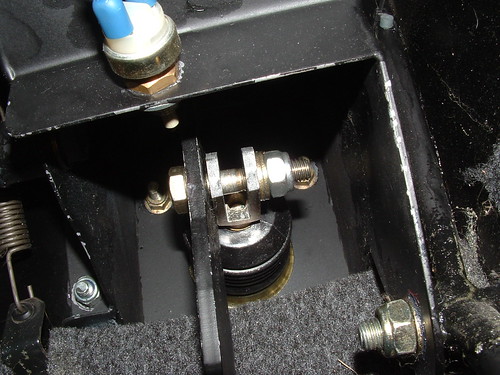


If you look carefully at the above photo, the clevis side is not parallel with the side face of the brake pedal - instead it has had the two holes elongated and been allowed to take up the line (parallel) of the servo push rod, thereby avoiding placing any side forces in to the servo. Also the nyloc has not been done up too tight to force the clevis over to the pedal side.


For those whose pedals have a hole,and/or the clevis lines up to fit around the pedal, rather than alongside, the principles to apply are the same: the final connection of the pedal to the clevis, must allow it to rotate laterally to line up in parallel to the servo input shaft.


I have modified my pedal arrangement, but the priciple can be seen above. The hole in the pedal has been made oval allowing the pin to rotate laterally and line up with the holes in the clevis without introducing strain.

Although this may sound complicated when you read it, when you look at the attached photos in detail, and have a look at your own installation, you will see the alignment issue, and hopefully understand what is required to ensure a safe long term workable solution

If anyone still has any concerns, please do give me a call, and I will try to talk you through the issue.

To those of you that have recognised this issue already and dealt with it, I apologise for teaching Granny to suck eggs! - but as the old adage goes " Better safe than sorry".

For anyone who does not like the idea of making the clevis holes oval with a 10mm drill bit, a rose joint provides the perfect solution allowing the correct angle at all times. These are not expensive, and can be fitted to the pedal bolt tightly without issue. You will require a female thread 3/8" UNF, as below.


Kind regards to all

Mike
22 Jul 2012, 6:44pm
I have had a failure of my pedal box involving the weld for the clutch pedal mount, it has let go and now the clutch pedal twists when you depress it.
Not sure if anyone else has had this issue yet but it is something worth looking at and maybe some beefing up around the pedal mount would be advised.

Whilst my pedal box is out for repair I have decided to fit the new dual servo and have a few questions.

I have disc brakes all round and my original master cylinder (I believe this to be a BMW unit) has only two outlets one for front and one for back brakes.

1. What master cylinder should I get to fit the new servo only giving me 2 outlets?
2. Do i need a valve inline with back brakes to give me a offset?
3. do i need any other parts other than the adapter plate and clevis supplied with the servo?
4. The clutch pedal was connected using the furthest away hole which I believe to make the pedal a lot harder to press, can I use the first hole and would I get enough travel to release the clutch if I do?

Thanks Stuart
22 Jul 2012, 7:24pm
1. What master cylinder should I get to fit the new servo only giving me 2 outlets?

I used the Ford one which has three outlets (two for front one for back) I just blanked off one of the front outlets with a suitable bolt and copper washer. The two front outlets are siamesed so that is fine.
2. Do i need a valve inline with back brakes to give me a offset?

I didn't use one and it's fine.
3. do i need any other parts other than the adapter plate and clevis supplied with the servo?

Just the master cylinder of your choice and you may need to extend the pushrod of the servo to the master cylinder. I used a long M6 caphead bolt. Oh - and you may have to extend the brake lines depending on how they were run originaly. I got away with just extending one.

No idea about 4!

Robin
22 Jul 2012, 10:19pm
Stuart wrote:
I have had a failure of my pedal box involving the weld for the clutch pedal mount, it has let go and now the clutch pedal twists when you depress it.
Not sure if anyone else has had this issue yet but it is something worth looking at and maybe some beefing up around the pedal mount would be advised.

Whilst my pedal box is out for repair I have decided to fit the new dual servo and have a few questions.

I have disc brakes all round and my original master cylinder (I believe this to be a BMW unit) has only two outlets one for front and one for back brakes.

1. What master cylinder should I get to fit the new servo only giving me 2 outlets?
2. Do i need a valve inline with back brakes to give me a offset?
3. do i need any other parts other than the adapter plate and clevis supplied with the servo?
4. The clutch pedal was connected using the furthest away hole which I believe to make the pedal a lot harder to press, can I use the first hole and would I get enough travel to release the clutch if I do?

Thanks Stuart


Hi Stuart

Ref 3 & 4:
3. Check how well your servo clevis lines up with your brake pedal. Having seen how one of our group just bolted it up, without checking the alignment, I would advise making sure it can align without placing a sideways pressure into the servo. If yours lines up when you offer it up - great. If it clearly does not, then I would suggst changing the clevis for a rose joint, which will accomodate any miss alignment.
See thread 636 below.

4. Are you using the standard E36 clutch master cylinder. I hooked mine up to the top hole first, and found it was a very hard clutch, and required very little travel before it parted. (It is easy to test by putting the car in gear with the engine off, and then ask someone to turn a rear wheel whilst you slowly depress the clutch). This will tell you how much of your clutch travel you actually need. I swapped to the lower hole and it was noticably easier, and the travel was normal.

......but every Marlin is different!

Mike
22 Jul 2012, 10:27pm
Stuart wrote:
I have had a failure of my pedal box involving the weld for the clutch pedal mount, it has let go and now the clutch pedal twists when you depress it.
Not sure if anyone else has had this issue yet but it is something worth looking at and maybe some beefing up around the pedal mount would be advised.


When I was installing my dual diaphragm brake servo I noticed that the pedal box side deforms and twists when I press my clutch.
My pedal box uses the BMW e30 clutch master cylinder.

I'm thinking of adding a supporting bracket on the battery box similar to Ian Morris' installation....

http://www.flickr.com/photos/58068042@N07/6696285663/

Can you get a picture of where yours has failed?

...peter
23 Jul 2012, 4:00pm
peterux wrote:
When I was installing my dual diaphragm brake servo I noticed that the pedal box side deforms and twists when I press my clutch.
My pedal box uses the BMW e30 clutch master cylinder.

I'm thinking of adding a supporting bracket on the battery box similar to Ian Morris' installation....

http://www.flickr.com/photos/58068042@N07/6696285663/

Can you get a picture of where yours has failed?

...peter


Peter

The weld around the tube the pedal bolts through has given way also the only strengthening brace has buckled.

Not a good picture but I hope you can get to see the issue.


I have sent it away to be welded and have some extra strengthening fillets fitted if it still flexes when i refit then I may well look at Ian's resolution.

I have also now ordered a BMC4052 Master Cylinder through Brakes International bargain at £38

Stuart
23 Jul 2012, 8:17pm
I also strengthen the pedal box a lot:


The metal the throttle pedal sits resembles tinfoil. The clutch pedal assembly just didn't work, so I installed a willwood master cylinder and the cage for the master cylinder taking the stresses away from the pedal box:


See the smaller nuts inside the ground cable loop and towards the front - thats where the cage is bolted to. There is a thicker plate on the top to re-enforce the area.

You can see the clutch master installation here:


I'm considering options to change the whole thing to a properly design and tested pedal box system, but not had enough time to look into it recently.
25 Jul 2012, 5:24pm
Stuart wrote:
Peter

The weld around the tube the pedal bolts through has given way also the only strengthening brace has buckled.

Not a good picture but I hope you can get to see the issue.


I have sent it away to be welded and have some extra strengthening fillets fitted if it still flexes when i refit then I may well look at Ian's resolution.

I have also now ordered a BMC4052 Master Cylinder through Brakes International bargain at £38

Stuart

Thanks, Stuart, I can see the failure. I think Ian's mod should prevent this kind of problem. I'll have to add it to my list of winter jobs.:smile:
...Peter
11 Nov 2012, 7:17pm
Rose Joint

Due to the alignment of the servo with the brake pedal, which seems to vary from car to car, and has caused some owners a problem with using a clevis, it is a good idea to use a rose joint instead to connect the pedal to the new servo.

The correct rose joint is a 3/8" x 3/8" female right hand thread rose joint. Patrick sourced his from:

http://www.ebay.co.uk/itm/180425540596

They sound good quality, and are remarkably good value at only £9.50 including postage.
12 Nov 2012, 11:08am
Hmm, interesting.

Must admit I did not read fully previous threads regarding this issue because when I fitted my clevis pin it just slotted perfectly into place with only a few turns to line up the holes. But the servo assembly is mounted on the angled bulkhead just like everyone elses, so must create that same angle at the clevis pin / pedal fixing point.

So, in retrospect. its logical that I change the clevis pin for the rose fitting to avoid premature failure of the servo unit due to the angle created.

Hope I have understood the problem correctly.

Difficult to lie on your back on the floor of the car and look up while someone pushes the pedal to see how it all works.

By the way Patrick, the fitting of your servo and the associated pipework is a work of art, beautiful to look at ( like the rest of the car ).

Interesting thought occured,................ as you are all thinking about possibly changing your brake pipes because of the ethanol problem ( deteriorisation of pipes ) how does that affect our daily runabouts ? Those of us who have petrol cars that is ?
12 Nov 2012, 11:44am
denniswpearce wrote:
Hmm, interesting.

Must admit I did not read fully previous threads regarding this issue because when I fitted my clevis pin it just slotted perfectly into place with only a few turns to line up the holes. But the servo assembly is mounted on the angled bulkhead just like everyone elses, so must create that same angle at the clevis pin / pedal fixing point.

So, in retrospect. its logical that I change the clevis pin for the rose fitting to avoid premature failure of the servo unit due to the angle created.

Hope I have understood the problem correctly.


Hi Dennis

If your clevis lined up with your pedal, and you did not have to force the pedal, or pin, to get it through both clevis holes - (very difficult to do, when you are lying on your back, with both feet stuck up in the air, struggling to get both hands in to a restricted space!) - then I think you are fortunate and you don't need to make any changes. Yours should be fine.

My suggestion was primarily aimed at those yet to fit their servos, and anyone who struggled to make the clevis/pedal/pin line up.
For the sake of a £10 rose joint, it guarantees making the fitting easy and safe.

My suggestion was prompted when I saw Dave Cunnington's Cabrio. His brake pedal had had the bolt welded in place, and meant the clevis would only fit by using significant lateral force.
In situations like this, it is would have been much easier from the outset to have started with a rose joint, which is designed to accommodate angle changes.
12 Nov 2012, 2:06pm
Thanks Dennis :)

I think it would have been Ok without the rose joint as there is minimal movement. On thinking about it I decided to do it anyway as I had everything out and it meant removing any slop between the pedal and the servo - even if it was minimal. As a technical solution I like it better than the old setup. Also have all my pedals on needle bearings so it made sense to have the connection to the servo on a bearing too.