This is a read-only archive of the old Madabout Kitcars forum. New posts and replies are no longer possible, but every thread is still here to browse and read.
Hi Mike. As per my earlier PM, Many thanks for servo received today.
Now starting to do some measuring and checking before starting the swap over.
Question: In an earlier post you said that the dual servo had an adjustable output shaft so a spacer wasn't needed between this and the master cylinder to compensate for the adaptor plate thickness. You also showed a photo ( I can't seem to copy and paste it into this post) of the output shaft unscrewed quite a long way. The dual servo that I have received has a similar, albeit smaller, domed screw and locknut but it is very tight. How did you undo yours? I am scratching around my tool box looking for some very small cranked ring spanners but will wait for your reply before fiddling too much. I notice that the output shaft is quite flexible and rotates freely in the rubber seal so is not actually physically connected to the input (pedal) shaft. Presumably it locates inside the servo in a similar "plunger & cup" arrangement as the output shaft-to-master cylinder connection? Peter.
Mine arrived today personally delivered by Richard who I thank very much for taking the time to do so. Also Thanks to Mike for all his efforts in ordering the items.
My servo arrived today too, thanks very much Mike.
It's MASSIVE. Much bigger than I was expecting from the photos. It looks just how you would expect a "Made in the USA" metro servo to turn out
I've done a very quick measure up and as Pete says, can see a few bits of fettling needed. the pedal box mount will need some of the bolt holes filing out and I also hit the same question mark with the out put connection to the master cylinder but was sent to the supermarket before I could give it any real thought. Will have to go back through this now epic thread and the photos to see what's what
Question: In an earlier post you said that the dual servo had an adjustable output shaft so a spacer wasn't needed between this and the master cylinder to compensate for the adaptor plate thickness. You also showed a photo ( I can't seem to copy and paste it into this post) of the output shaft unscrewed quite a long way. The dual servo that I have received has a similar, albeit smaller, domed screw and locknut but it is very tight. How did you undo yours?
I had a 'fiddle' with mine tonight. It's a 7mm ring spanner or socket to go over the hex head. I held the lock ring with a pair of thin nose pliers (bent snipe nose pliers would be better but I don't own any of those) and it came undone without to much force. The 'lock ring' is a brass coloured serrated ring. (you need to turn the spanner clockwise whilst holding the ring stationary to unlock the ring and then it came out with my fingers).
Surprisingly, it seems to be a 6mm metric thread which is good as it opens up the options to fit a longer plunger if necessary.
The serrated lock ring will need to be tightened to lock it again. I guess with the brake pedal compressed it will stick out a lot further and make it easier to get at.
Pete(V8), I managed to undo my plunger extender with a 7mm socket and a pair of long nose pliers to hold the lock nut in place. it only extends about 2cm so I think should be kept for fine adjustment.
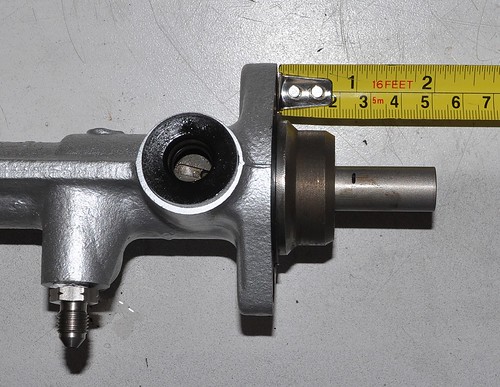
For anyone else using an E30 master cylinder (which I don't think has been tested yet), you'll hit a problem with the length of the push rod bit being too much
Basically the seat inside the Servo is 25mm deep with the adapter plate installed. From the E30 fixing face to the end of the M/C push rod uncompressed is 50mm so a few options could be
1. Cut 25mm off the end of the push rod. Easiest way to proceed but it depends if there are seals 25mm inside the M/S that would leak if you press the brake pedal down too far.
2. Create a further adapter 25mm thick to stand the M/C off the servo or layer up a total of 4 of the existing adapter to make the trim cut on the M/C just 10mm. This may push the M/C too far forward so it fouls the side of the bonnet or side panels
3. Stand off spacers for the M/C. As far as I understand it the servo is a sealed unit so the M/C to servo interface doesn't require an air tight seal
4. chuck the BMW M/C and buy a ford one
5. something else entirely (open to suggestions)
I think trimming the M/C pushrod is the most likely solution but looking at Mikes photos, I'm still surprised this is an issue as the ford one looks very similar
[COLOR="Magenta"][EDIT] no it doesn't, it quite clearly doesn't have the protuding push rod[/COLOR]
Question: In an earlier post you said that the dual servo had an adjustable output shaft so a spacer wasn't needed between this and the master cylinder to compensate for the adaptor plate thickness. You also showed a photo ( I can't seem to copy and paste it into this post) of the output shaft unscrewed quite a long way. The dual servo that I have received has a similar, albeit smaller, domed screw and locknut but it is very tight. How did you undo yours? I am scratching around my tool box looking for some very small cranked ring spanners but will wait for your reply before fiddling too much. I notice that the output shaft is quite flexible and rotates freely in the rubber seal so is not actually physically connected to the input (pedal) shaft. Presumably it locates inside the servo in a similar "plunger & cup" arrangement as the output shaft-to-master cylinder connection? Peter.
Hi Peter
This may not affect everyone - the first one I checked was tight, the second loose.
I found the easiest way to deal with the problem was to use a large G-clamp to compress the input push rod in to the servo: the output end then becomes, and remains, easily accessible. Do not try to hold the output shaft with a pair of pliers, as the shaft has to make an air tight seal, and any marking of it may cause the seal to fail.
You may find the length of the fitted bolt insufficient to adjust out to the depth of your master cylinder. A longer threaded bolt will solve the problem.
If you want to be really particular, file the head in to a dome shape.
Pete(V8), I managed to undo my plunger extender with a 7mm socket and a pair of long nose pliers to hold the lock nut in place. it only extends about 2cm so I think should be kept for fine adjustment.
For anyone else using an E30 master cylinder (which I don't think has been tested yet), you'll hit a problem with the length of the push rod bit being too much
Basically the seat inside the Servo is 25mm deep with the adapter plate installed. From the E30 fixing face to the end of the M/C push rod uncompressed is 50mm so a few options could be
1. Cut 25mm off the end of the push rod. Easiest way to proceed but it depends if there are seals 25mm inside the M/S that would leak if you press the brake pedal down too far.
2. Create a further adapter 25mm thick to stand the M/C off the servo or layer up a total of 4 of the existing adapter to make the trim cut on the M/C just 10mm. This may push the M/C too far forward so it fouls the side of the bonnet or side panels
3. Stand off spacers for the M/C. As far as I understand it the servo is a sealed unit so the M/C to servo interface doesn't require an air tight seal
4. chuck the BMW M/C and buy a ford one
5. something else entirely (open to suggestions)
I think trimming the M/C pushrod is the most likely solution but looking at Mikes photos, I'm still surprised this is an issue as the ford one looks very similar
[COLOR="Magenta"][EDIT] no it doesn't, it quite clearly doesn't have the protuding push rod[/COLOR]
Oh bugger, Option 4 looks the best!
Has anyone established a part number for the Ford type?
I've seen some with pipe exits on the left and some on the right. The Ford Cortina ones have exits on the right but I think Jason's are on the left?
Has anyone established a part number for the Ford type?
I've seen some with pipe exits on the left and some on the right. The Ford Cortina ones have exits on the right but I think Jason's are on the left?
I guess it's another Marlin secret part number
Peter
I'm sad to say that was my conclusion (option 4) - Buy a Ford brake master cylinder. be careful of the bore size. Too big and you will end up back where you started.
Simon Gregory fitted one from an XR4i and said it is good. Peter Morris fitted one from a 1.8 LX Sierra one and said it was good too! The smaller the diameter, the better the brake pressure will be: the down side being more pedal travel for the same effect.
The situation with the Ford master cylinder is even worse than you imply. There are also two very different flange sizes and hole centres! I beleive the better one to get is Lucas Girling, and not the Bendix one. The adaptor plate has been supplied with an etched 70mm pcd for the smaller flanged BMC, with holes at 70mm centres (Lucas Girling? - please check first though).
I have seen ones like I chose advertised for Transit Vans. John Tootle (Cabrioman) was going to investigate this - don't know how far he got.
Bugger! Anyone want a new E30 master cylinder to go with the new metro servo I also have available!!! It's a serious business getting decent brakes but I am sure it will be worth it.
When I measured the flange depth, Mike, I did not realize that the Ford m/c does not have the protruding push rod. I should have looked more closely at the whole combination. Sadly, in my view the only sensible option is a new (unknown) m/c.
Incidentally, how much force is needed to push in the operating rod on the servo. Mine has light force free play of about 2mm and then seems to hit a mechanical stop which I cannot overcome pushing against a block of wood with reasonable force. The output rod does not move and I am loath to risk damage.
Bugger! Anyone want a new E30 master cylinder to go with the new metro servo I also have available!!! It's a serious business getting decent brakes but I am sure it will be worth it.
When I measured the flange depth, Mike, I did not realize that the Ford m/c does not have the protruding push rod. I should have looked more closely at the whole combination. Sadly, in my view the only sensible option is a new (unknown) m/c.
Incidentally, how much force is needed to push in the operating rod on the servo. Mine has light force free play of about 2mm and then seems to hit a mechanical stop which I cannot overcome pushing against a block of wood with reasonable force. The output rod does not move and I am loath to risk damage.
Hi Sorton
Yes, I have made a few purchases that I have later made redundant - a new metro servo being one! I think there are a lot of us in that situation. Except I welded my extension pushrod to the servo so it is now scrap!
I also agree the best solution is to go for a new / re-manufactured master cylinder. I've just seen a Cortina with a 20mm bore which would be better than my 22mm bore, but I'm not sure about the size of the flange fitting. (another redundant ebay purchase taught me that there are different flange sizes)
With regard to compression force - there is a hefty return spring in the servo, which makes it quite hard to compress. I could not hold it down AND undo the adjustable thread - hence my advice to use a large G-clamp to compress it. Then it is easy to adjust the output threaded stud.
If the metro servo works with the BMW master cylinder then why not the Dual Servo? The plunger arrangment in the Metro servo looked quite similar to that of the dual servo when I looked at my spare metro servo last night.
As I remember the operating rod on the master cylinder is hollow and the plunger from the servo goes up the middle.
Cheers
Robin
Edit: OK - I looked at the picture of the cutway servo. I can see the problem now. The dual servo has a seat that the metro servo didn't have. The metro servo relying on the tip of the push rod instead.
That's right, Robin. But the dual servo has an M6 threaded pushrod that you can lengthen or shorten to ensure that there is no slack before the pushrod hits the master cylinder.
Before we all go and buy new master cylinders wouldn't it be worth:
1. Working out how much the push rod can move when the brake pedal is flat on the floor.
2. If, in this position there would still some operating rod visible on the master cylinder, then it would be safe to shorten it.
However I guess that shortening it may not be that easy. From its color I guess that the operating rod is made of a high carbon steel. Will probably need a cutting disc in an angle grinder.
The dual servo is a sealed unit, and has a closed recess of only 25mm deep.
Mike
MartinClan wrote:
I'm confused.
If the metro servo works with the BMW master cylinder then why not the Dual Servo? The plunger arrangment in the Metro servo looked quite similar to that of the dual servo when I looked at my spare metro servo last night.
As I remember the operating rod on the master cylinder is hollow and the plunger from the servo goes up the middle.
Cheers
Robin
Edit: OK - I looked at the picture of the cutway servo. I can see the problem now. The dual servo has a seat that the metro servo didn't have. The metro servo relying on the tip of the push rod instead.
The brake master cylinder has to be one of the most significant safety critical items on any car. Embarking on a procedure to cut and carve must be undertaken with great care.
Suitable new master cylinders are available for £30-40: is it really worth the effort, and risk?
Mike
MartinClan wrote:
Before we all go and buy new master cylinders wouldn't it be worth:
1. Working out how much the push rod can move when the brake pedal is flat on the floor.
2. If, in this position there would still some operating rod visible on the master cylinder, then it would be safe to shorten it.
However I guess that shortening it may not be that easy. From its color I guess that the operating rod is made of a high carbon steel. Will probably need a cutting disc in an angle grinder.